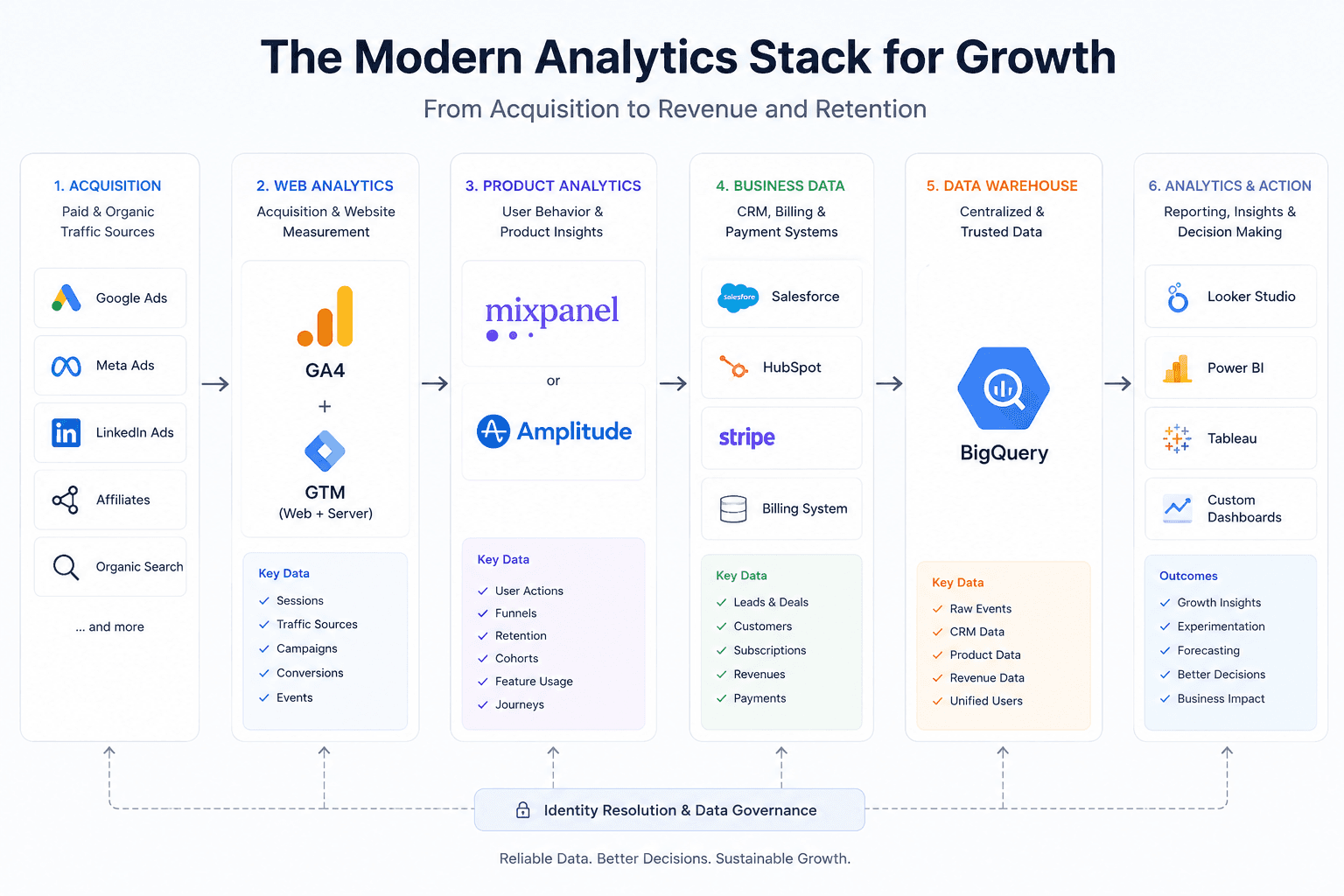
Marketing Data Infrastructure Consultant: Scope, Architecture & Cost
A buyer's guide for teams that need trustworthy marketing decisions—not another dashboard connected to unreconciled data.
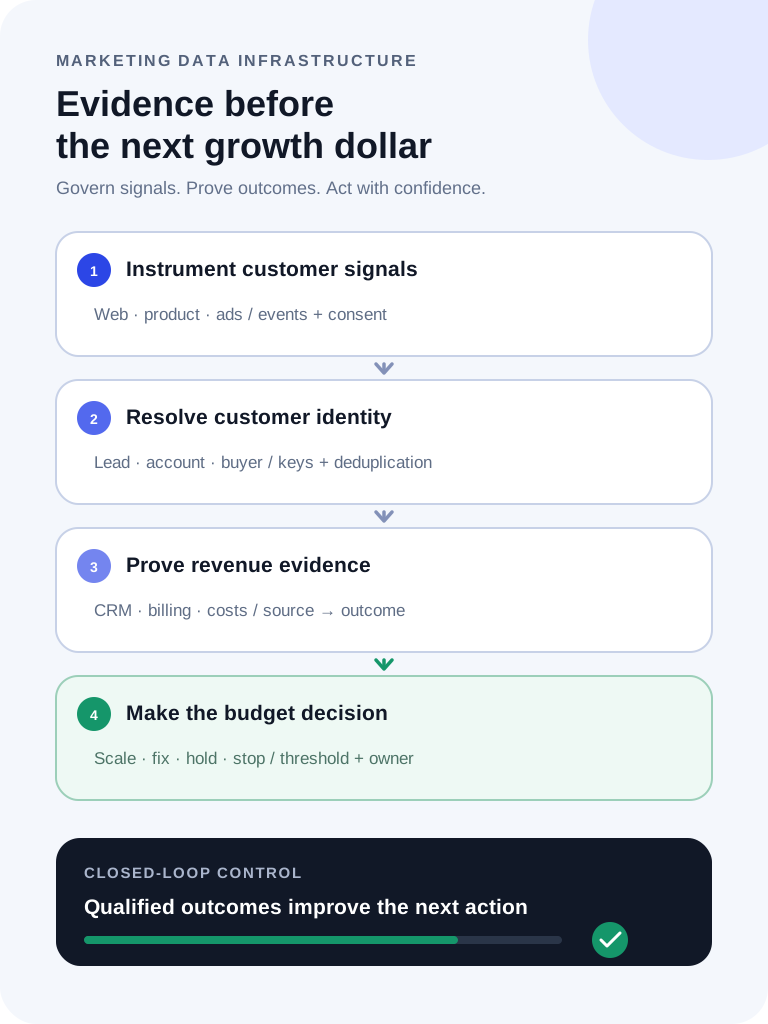
A marketing data infrastructure consultant should design the path from a customer action to a business decision. That path may include website and product events, campaign identifiers, consent, customer identity, CRM stages, billing outcomes, warehouse models, dashboards and conversion feedback to advertising platforms. The engagement is successful only when the resulting data is defined, testable, owned and useful for allocating money.
The mistake is to buy tools before defining decisions. GA4, GTM, a CRM, a warehouse and a BI platform can all be configured correctly while leadership still cannot explain why revenue differs across systems, which leads became customers or whether the next budget increase is profitable.
The short answer
Hire specialist support when fragmented measurement is changing material decisions: budget allocation, funnel prioritization, forecasting, lead quality, unit economics or experimentation. A useful engagement begins with those decisions, audits the evidence required for each one, identifies loss between systems and builds the smallest reliable architecture that closes the gap.
The output should not be a generic stack diagram. It should be an operating contract: what is collected, where identity is resolved, which system owns each field, how numbers reconcile, which checks run, who responds to failures and how qualified revenue outcomes return to acquisition platforms.
What a marketing data infrastructure consultant should own
Marketing analytics infrastructure consulting spans strategy and implementation. The consultant does not need to replace every engineer, analyst or marketer. They do need to make dependencies explicit and keep the full chain coherent.
Table 1. Minimum scope for a decision-grade marketing data infrastructure engagement
Swipe horizontally to view all columns →
Table 1. Minimum scope for a decision-grade marketing data infrastructure engagement
Workstream
Question
Evidence at handover
Decision contract
Which recurring decisions must the system support?
Decision, metric, cadence, owner and threshold map
Collection
Are the right events and identifiers captured consistently?
Event specification, data-layer contract and QA results
Identity
How do sessions, leads, accounts and customers connect?
Identity hierarchy, join rules and known limitations
Modeling
How do raw records become agreed business metrics?
Source-of-truth rules, transformations and reconciliation
Activation
Can qualified outcomes improve targeting and bidding?
Destination map, payload rules, diagnostics and monitoring
Governance
Who owns quality, consent and change control?
Owners, access, release process and incident playbook
A marketing data stack consultant should also be willing to recommend fewer tools. If a clean GA4 and CRM connection answers the current decision, a warehouse may be premature. If historical raw events, account-level joins and durable models are required, postponing the warehouse can be equally expensive.
A decision-first marketing data architecture
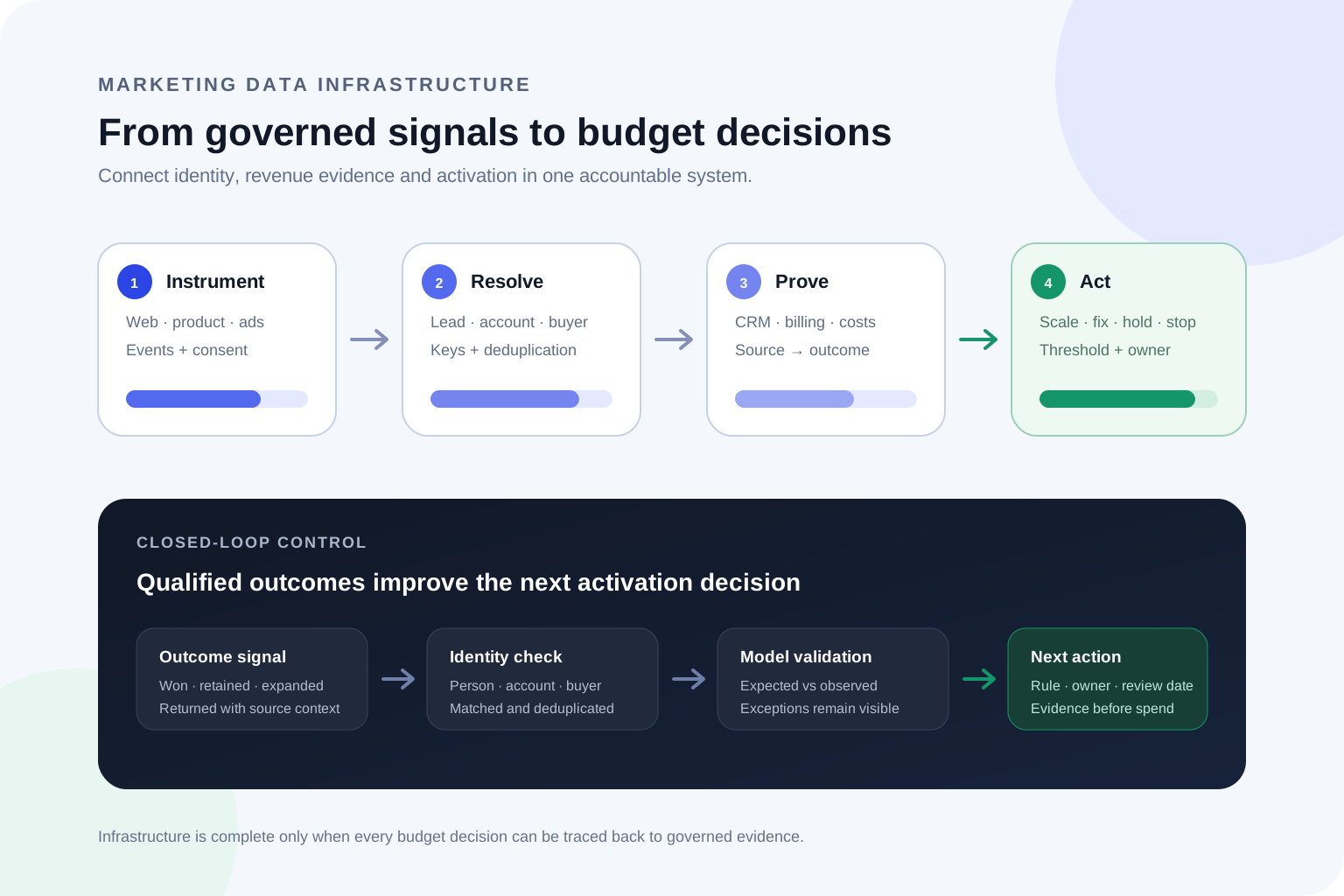
The architecture should follow evidence in one direction and learning in the other. Customer interactions become governed events; events and business records become identities and modeled outcomes; outcomes become decisions; selected outcomes return to activation platforms.
Decision-first architecture
Evidence moves forward; qualified outcomes create a feedback loop
01 · Collect
Governed customer events
Capture required events, campaign IDs and consent state.
02 · Resolve
Stable customer identity
Connect sessions, leads, accounts and billing records.
03 · Model
Reconciled outcomes
Transform evidence into agreed funnel, revenue and economics metrics.
04 · Decide
Budget and product action
Apply thresholds, owners and an explicit review cadence.
05 · Activate
Feedback to platforms
Return eligible outcomes and monitor delivery quality.
Revenue and qualification signals return to acquisition systems under consent and destination rules
Tools are replaceable layers. Definitions, identity rules, quality controls and ownership make the infrastructure durable.
Google's official documentation confirms that GA4 properties can export raw events to BigQuery. That export creates flexibility for SQL analysis and cross-system modeling, but the export alone does not define customer identity or reconcile revenue. See the official GA4 BigQuery Export guide.
If the target stack is already defined and the buying question is narrower, use the GA4 + BigQuery implementation cost guide for SaaS. This infrastructure guide addresses the broader decision of which layers are required and how they should operate together.
Likewise, Google describes server-side tagging as a way to process measurement data in a server container, with benefits for performance, security and data control. It is a transport and governance option—not a substitute for an event contract or consent policy. Review the official server-side tagging documentation. If that layer is already the defined need, compare the narrower server-side tagging implementation scope and hiring criteria.
Table 2. Choose the next architecture layer by decision need
Swipe horizontally to view all columns →
Table 2. Choose the next architecture layer by decision need
Need
Likely minimum layer
Do not assume
Reliable website conversion reporting
Data layer, GTM, GA4, consent and QA
A warehouse is automatically required
Lead-to-revenue attribution
Click IDs, CRM stages, stable identity and outcome import
A form submit represents revenue
Cross-channel customer economics
Warehouse, billing/CRM joins and governed metric models
Platform attribution can be summed
Product behavior analysis
Event taxonomy plus fit-for-purpose product analytics
Tool choice fixes poor instrumentation
Privacy-aware activation
Consent state, allowed payloads and monitored destinations
Server-side means consent-free
If the current decision is choosing a behavioral analytics layer, use the GA4 vs Mixpanel vs Amplitude comparison. That decision belongs inside the architecture, not above it.
Marketing data infrastructure audit and implementation process
A credible marketing data infrastructure audit should expose the gap before prescribing the build. The following sequence keeps the work tied to business value.
If you need diagnosis and a prioritized roadmap before committing to implementation, compare the dedicated marketing analytics audit scope, pricing and deliverables. An infrastructure consulting engagement continues from that diagnosis into architecture, implementation and operational ownership.
Inventory decisions: list the budget, funnel, lifecycle and revenue decisions currently delayed or disputed.
Map required evidence: define metrics, dimensions, identifiers, latency and acceptable error for each decision.
Trace records end to end: test real sessions, leads, opportunities, purchases and refunds across systems.
Quantify leakage: separate missing collection, failed joins, taxonomy drift, duplicate events and delayed outcomes.
Design the target state: keep, repair, replace or add only the layers needed to close material gaps.
Implement in vertical slices: prove one high-value journey before migrating every event and report.
For a focused analytics-property review, the GA4 audit checklist provides a narrower diagnostic. Infrastructure consulting goes further by tracing customer and revenue evidence beyond the analytics interface.
Illustrative example: the hidden cost of data leakage
Consider a B2B company that records 1,000 monthly website leads. The advertising report optimizes to all 1,000, but only 620 leads retain a usable source identifier in the CRM. Of those, 500 reach a normalized qualification stage, 420 connect to an account and 380 can be joined to closed revenue.
Illustrative B2B record trace
Evidence remaining from lead capture to revenue
Website leads
1,000 · 100%
Source retained in CRM
620 · 62%
Qualification normalized
500 · 50%
Account identity joined
420 · 42%
Revenue joined
380 · 38%
Illustrative values, not a benchmark. The purpose is to quantify where decision evidence becomes incomplete.
Only 38% of initial lead records can support a complete acquisition-to-revenue analysis. This does not mean 62% of revenue is lost. It means the evidence used to allocate budget is incomplete and potentially biased toward sources that preserve identifiers more reliably.
Assume the company spends $120,000 and reports 60 customers from platform data, producing a $2,000 paid CAC. The CRM-reconciled dataset contains only 38 attributable customers, producing an observed $3,158 CAC for the traceable subset. Neither number is automatically the truth: the first may include modeled platform credit, while the second suffers from identity loss. The correct action is to repair capture and reconciliation before using either metric as a scaling rule.
This is why the existing distinction between blended CAC, paid CAC and marginal CAC matters. Infrastructure determines which numerator, customer population and acquisition source can be defended.
Deliverables and acceptance criteria
A proposal should name artifacts and tests, not only workshops. Depending on scope, the client should receive:
a decision and KPI contract with agreed definitions;
a current-state source, destination and identity map;
an event and campaign taxonomy with naming rules;
record-level reconciliation and quantified leakage findings;
a target architecture with trade-offs and phased backlog;
implemented tags, pipelines, models or activation connections within scope;
QA evidence for desktop, mobile, consent states and failure cases;
monitoring, ownership, access and change-control documentation;
a handover session and reproducible operating runbook.
Table 3. Example acceptance criteria for infrastructure work
Swipe horizontally to view all columns →
Table 3. Example acceptance criteria for infrastructure work
Area
Weak acceptance
Decision-grade acceptance
Events
“Tags fire”
Required fields pass test cases across devices and consent states
Identity
“CRM connected”
Join rate, duplicates and unmatched reasons are measured
Revenue
“Dashboard matches closely”
Variance to billing is quantified, explained and owned
Activation
“Conversions uploaded”
Payload, match diagnostics, latency and errors are monitored
Handover
“Documentation shared”
An internal owner can run QA and respond to a failure
For B2B teams, connect this scope to the Google Ads offline conversion tracking guide. Google now directs enhanced-conversion lead uploads toward Data Manager and its API, which makes current implementation guidance and diagnostics especially important.
Marketing analytics implementation cost and scope drivers
Marketing analytics implementation cost is driven less by the number of dashboards than by the number of boundaries the data must cross. Website-to-analytics is one boundary. Anonymous-to-known identity, CRM-to-billing, account hierarchies, refunds, consent regions and reverse activation each add design and QA work.
Table 4. What increases marketing data infrastructure scope
Swipe horizontally to view all columns →
Table 4. What increases marketing data infrastructure scope
Driver
Lower complexity
Higher complexity
Sources
One site, one CRM, one billing source
Multiple products, CRMs, regions or entities
Identity
Direct ecommerce purchase
Anonymous sessions, accounts, long sales cycles
History
Forward-only implementation
Backfill, migration and historical reconciliation
Activation
Reporting only
Multi-platform audiences and conversion feedback
Operations
Single owner and simple releases
Multiple teams, access tiers and compliance review
On this site, a Growth Analytics Audit starts from $1,000 and is appropriate when the first need is diagnosis and a prioritized roadmap. Broader Analytics Infrastructure work is scoped after the current state, dependencies and acceptance criteria are understood. Review the current engagement pricing rather than comparing hourly rates without scope.
If you want a low-friction starting point, the AI Growth Infrastructure Assessment can identify likely maturity gaps. It does not replace record-level testing, but it helps frame the first conversation.
How to choose a marketing data infrastructure consultant
Ask candidates to explain how their design changes a decision and how they will prove the implementation works. Useful questions include:
Which business decisions will you use to prioritize the architecture?
How will you trace a real customer from source to recognized revenue?
How will identity, consent and system ownership be documented?
Which reconciliation tests and acceptance thresholds will you define?
When would you advise us not to add a warehouse or new analytics tool?
How will implementation changes be tested across mobile, desktop and consent states?
What monitoring will detect silent data loss after launch?
What code, access, documentation and ownership remain with our team?
Red flags include a tool list before a decision inventory, promises of “100% accurate attribution,” no quantified reconciliation, architecture without consent and governance, dashboards built before metric definitions, or a dependency on undocumented consultant-owned logic.
Frequently asked questions
What does a marketing data infrastructure consultant do?
A consultant maps business decisions to measurement requirements, audits tracking and identity, reconciles advertising, analytics, CRM and revenue data, designs the target architecture, defines governance and QA, and helps implement a system the team can operate after handover.
How much does marketing data infrastructure consulting cost?
Cost depends on the number of sources, identity complexity, data quality, warehouse and activation requirements, privacy controls and implementation depth. On this site, a Growth Analytics Audit starts from $1,000, while broader infrastructure implementation is scoped after diagnosis.
Do we need a data warehouse before hiring a consultant?
No. A warehouse is useful when the business needs raw event history, cross-system joins, durable models or repeatable reporting. A consultant should first prove that the decisions and data volume justify that layer instead of prescribing a warehouse by default.
Is GA4 enough for marketing data infrastructure?
GA4 can be an important collection and analysis layer, but it is not automatically a complete infrastructure. Many companies also need CRM and billing reconciliation, stable customer identity, consent controls, data ownership, QA and a route for sending qualified outcomes back to advertising platforms.
How long does a marketing data infrastructure project take?
A focused audit can be completed faster than a multi-system implementation. Broader implementations on this site are generally planned over roughly two to six weeks, depending on access, source count, engineering dependencies, QA and stakeholder availability.
What should be included in a marketing data infrastructure audit?
The audit should include a decision inventory, source and event map, identity review, consent and governance review, reconciliation tests, data-quality scorecard, target architecture, prioritized roadmap, owners and acceptance criteria.
Share the decisions, systems and reporting gaps behind your current stack. The first step is to determine whether the constraint is collection, identity, modeling, activation or governance.
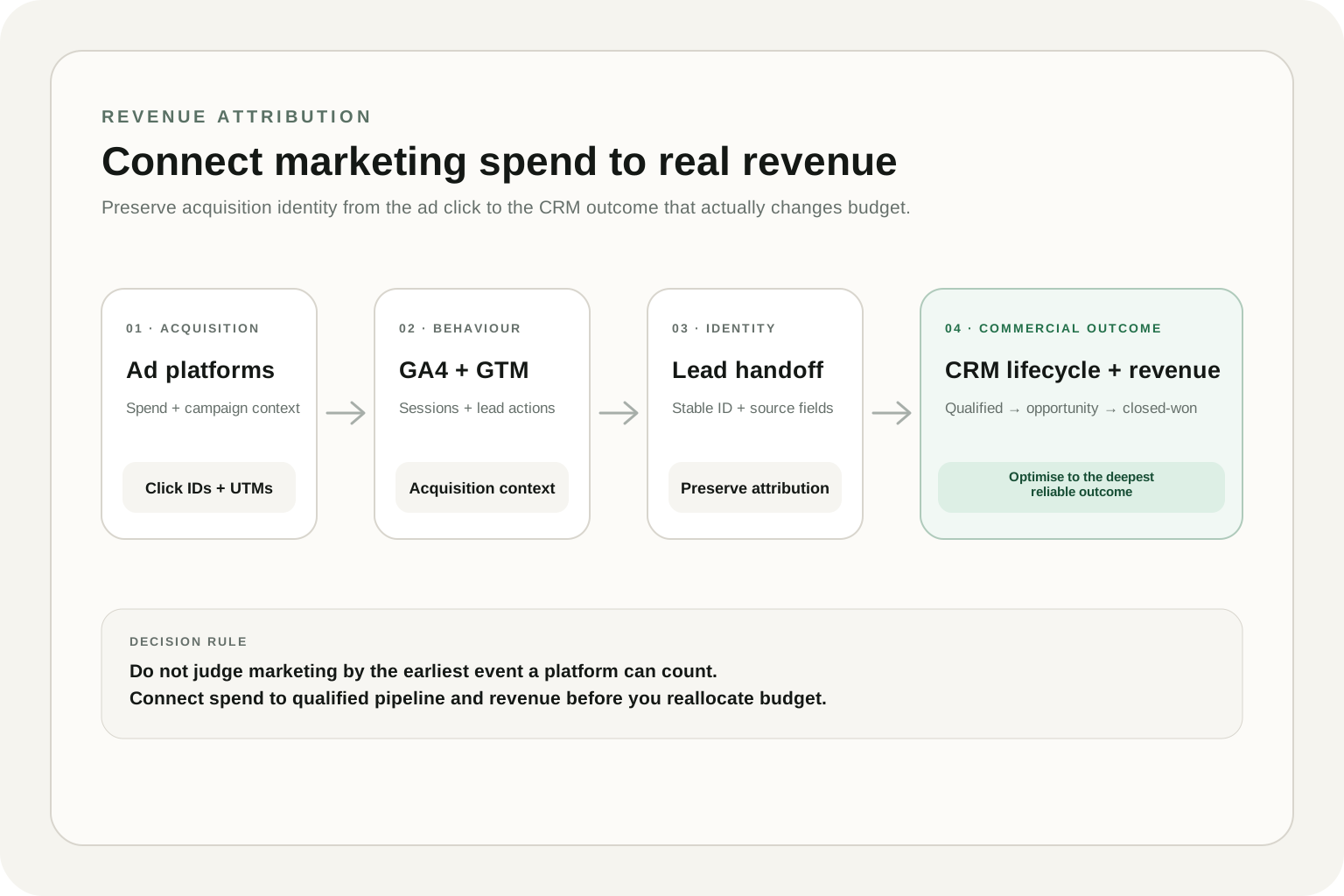
A practical architecture for connecting ad spend, GA4 lead data and CRM lifecycle outcomes to closed-won revenue without relying on platform-reported conversions alone.
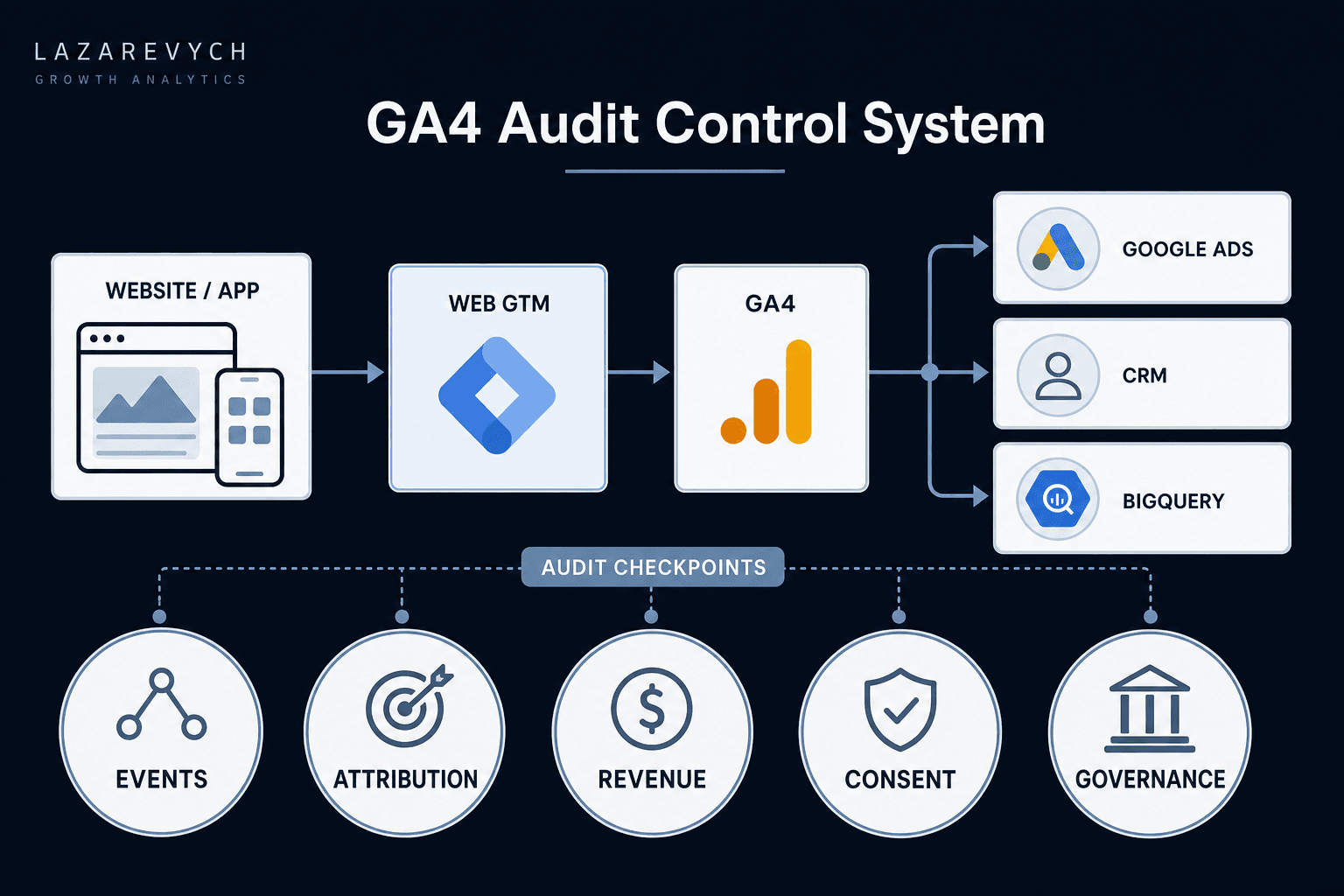
A practical GA4 audit framework for finding tracking, attribution, revenue and data-quality problems — and prioritising the issues that can damage business decisions.
A growing business rarely suffers from a lack of data. It suffers from having data in the wrong places, answering the wrong questions. Google Analytics 4 may show which campaigns generate registrations. A CRM may show which leads become customers. A billing platform may record subscription revenue. Meanwhile, the product team may still be unable…