Server-Side GTM Consultant: Cost, Scope & When to Hire
A decision-first buyer's guide for teams comparing server-side tagging specialists, implementation scope, hosting options and proof of a production-ready result.
A server side GTM consultant should determine whether a server-side layer is justified, design the collection and routing architecture, implement the agreed destinations, prove that browser and server events behave correctly, and leave the client with operational ownership. The deliverable is not merely a live server container. It is a measurement path that can be tested against real business outcomes.
That distinction matters because server-side Google Tag Manager is easy to oversell. It can provide more control over how approved measurement data is processed and forwarded. It does not automatically repair a weak data layer, resolve attribution disagreements, recover every blocked request, create legal permission to process data or turn GA4 into a revenue source of truth.
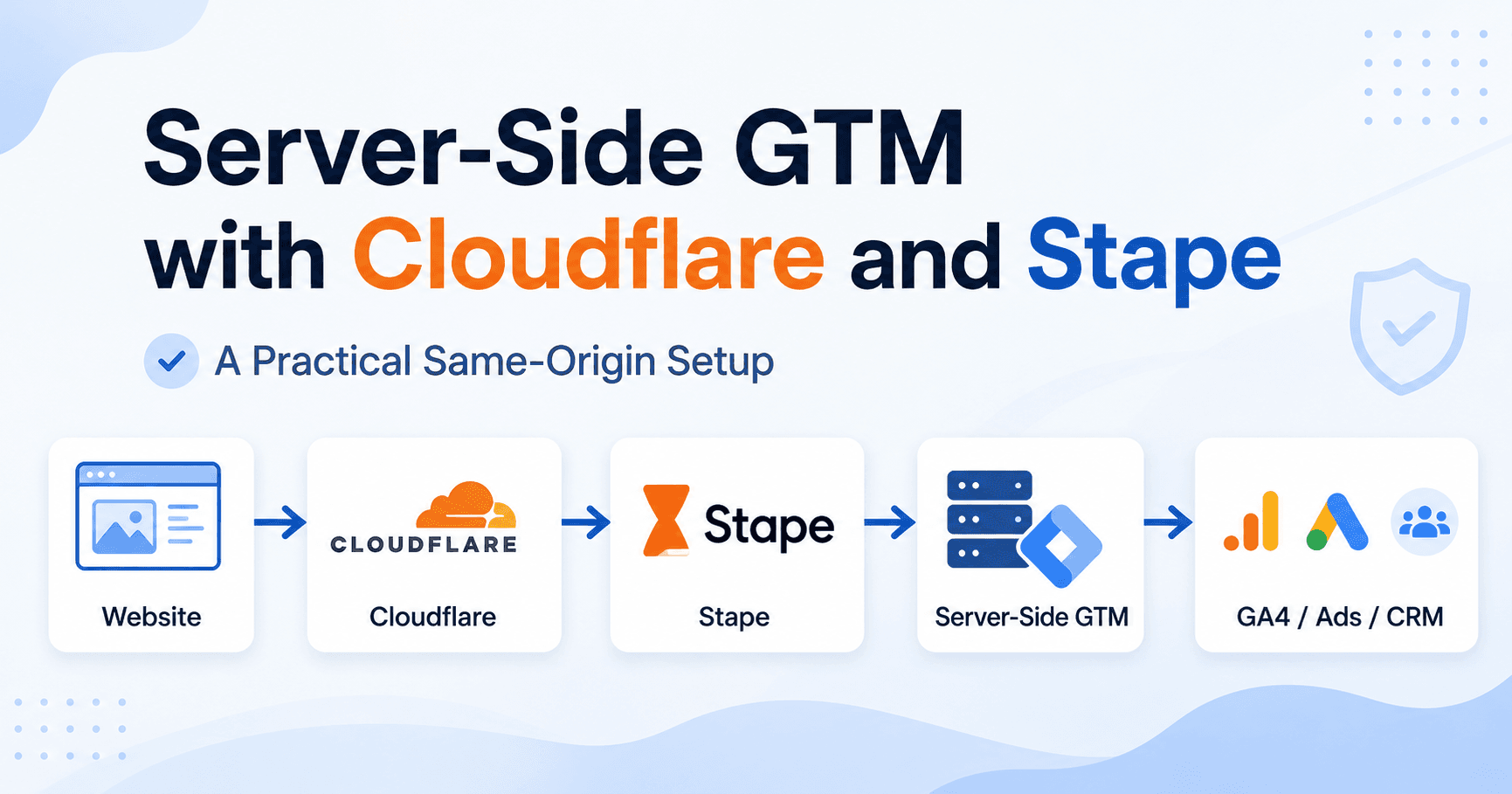
If your main question is how same-origin routing works with Cloudflare and managed hosting, use the existing technical Server-Side GTM with Cloudflare and Stape guide. This page owns the commercial decision: whether to hire, what the engagement should include, what drives cost and what evidence should be required before acceptance.
Direct answer: do you need a consultant?
Hire specialist support when a material budget or reporting decision depends on a collection path your team cannot confidently design, validate and operate. Typical signals include duplicated purchases, missing conversion identifiers, inconsistent consent behavior, Meta browser and server events that do not deduplicate, Google Ads conversions that cannot be reconciled, or a server container that nobody clearly owns.
Do not hire someone simply to make the account display a server container. A clean web implementation may be the correct next step when traffic is modest, paid media is limited, event definitions are unstable, the CRM contains no usable outcomes, or the business lacks an owner for the new infrastructure.
What a Server-Side GTM Consultant Actually Does
The role crosses analytics, advertising, consent implementation and technical operations. A capable server side tagging consultant should be able to work with the web data layer, Web GTM, the first-party collection endpoint, the server container, destination APIs, platform diagnostics and the system that records the commercial outcome.
The work normally includes five forms of ownership:
Decision ownership: identify the business outcomes that need a more reliable collection or activation path.
Architecture ownership: define the browser, endpoint, server container, destinations, identity and validation layers.
Implementation ownership: configure the scoped containers, tags, templates, transformations, consent behavior and infrastructure.
Quality ownership: test representative journeys, deduplicate events and reconcile results with CRM, order or billing records.
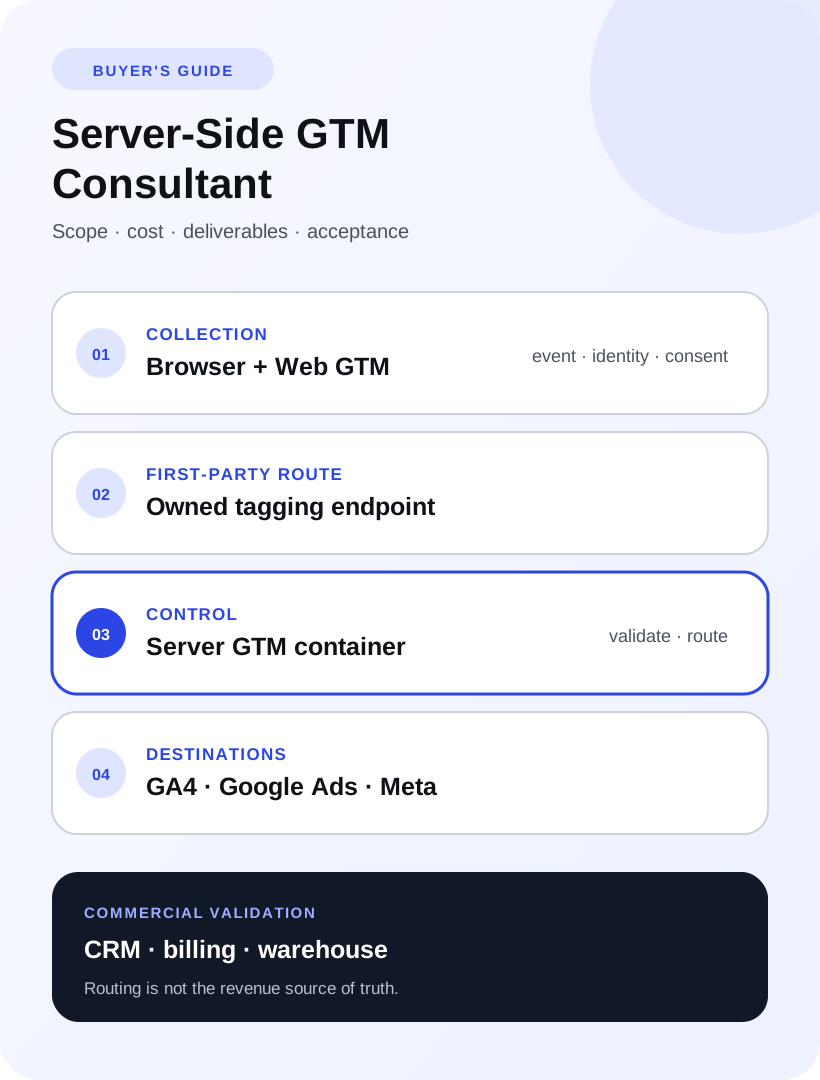
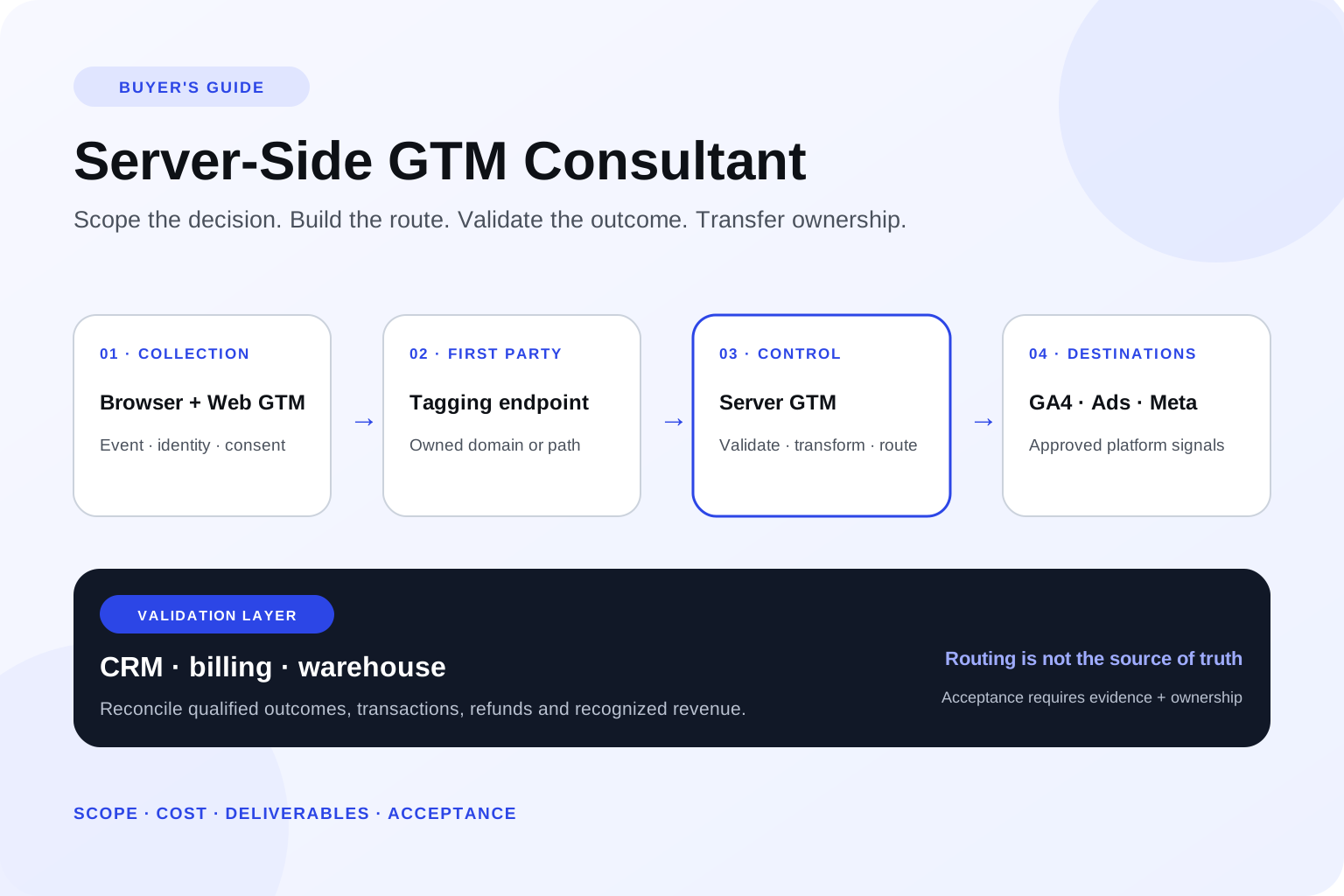
Route platform signals through a controlled layer—then validate them against business records
01Collection
Browser + Web GTM
Business event, identifiers and current consent state
→
02First-party route
Tagging endpoint
Owned domain or path forwards approved measurement requests
→
03Processing
Server GTM container
Clients claim requests; container rules validate, transform and route events
→
04Destinations
GA4 · Ads · Meta
Each platform receives only the defined payload and consent context
CRM · billing · warehouse validation
Reconcile qualified leads, purchases, refunds and recognized revenue. Server GTM routes evidence; it does not become the revenue source of truth.
Figure 1. A production server-side GTM implementation needs a governed collection path and a separate commercial validation layer.
Google describes server-side tagging as processing measurement data in a server container rather than relying only on browser-side destinations. Google also recommends a first-party context to obtain the security and durability benefits of server-set cookies. Review the official introduction to server-side tagging and custom-domain guidance. Those documents explain the platform behavior; the consultant still needs to connect it to the client's approved event and ownership model.
When is server-side GTM worth implementing?
Server-side GTM is most defensible when the business has valuable conversion signals, meaningful acquisition activity and a specific limitation that the additional control layer can address. It may be useful when several destinations need the same governed event, when the team wants a first-party tagging endpoint, when conversion payloads need controlled transformations, or when browser and server delivery must be coordinated across GA4, Google Ads and Meta.
Strong use cases usually have several of these characteristics:
paid media decisions depend on purchases or qualified leads;
GA4, ad-platform and CRM outcomes materially disagree;
the business needs Google Ads Enhanced Conversions or Meta CAPI;
the same event must be routed to several approved destinations;
consent state must be preserved and tested across the delivery path;
event payloads require minimization, enrichment or redaction;
multiple sites, domains or checkout boundaries complicate collection;
a named team can own hosting, monitoring and future changes.
When not to implement it yet
Postpone the server layer when the underlying event is not trustworthy. If one purchase fires twice in Web GTM, a server container can forward the duplicate perfectly. If the dataLayer does not expose transaction IDs or consent state, server-side routing does not invent them. If no one can reconcile platform conversions with orders or CRM stages, the team cannot demonstrate that the migration worked.
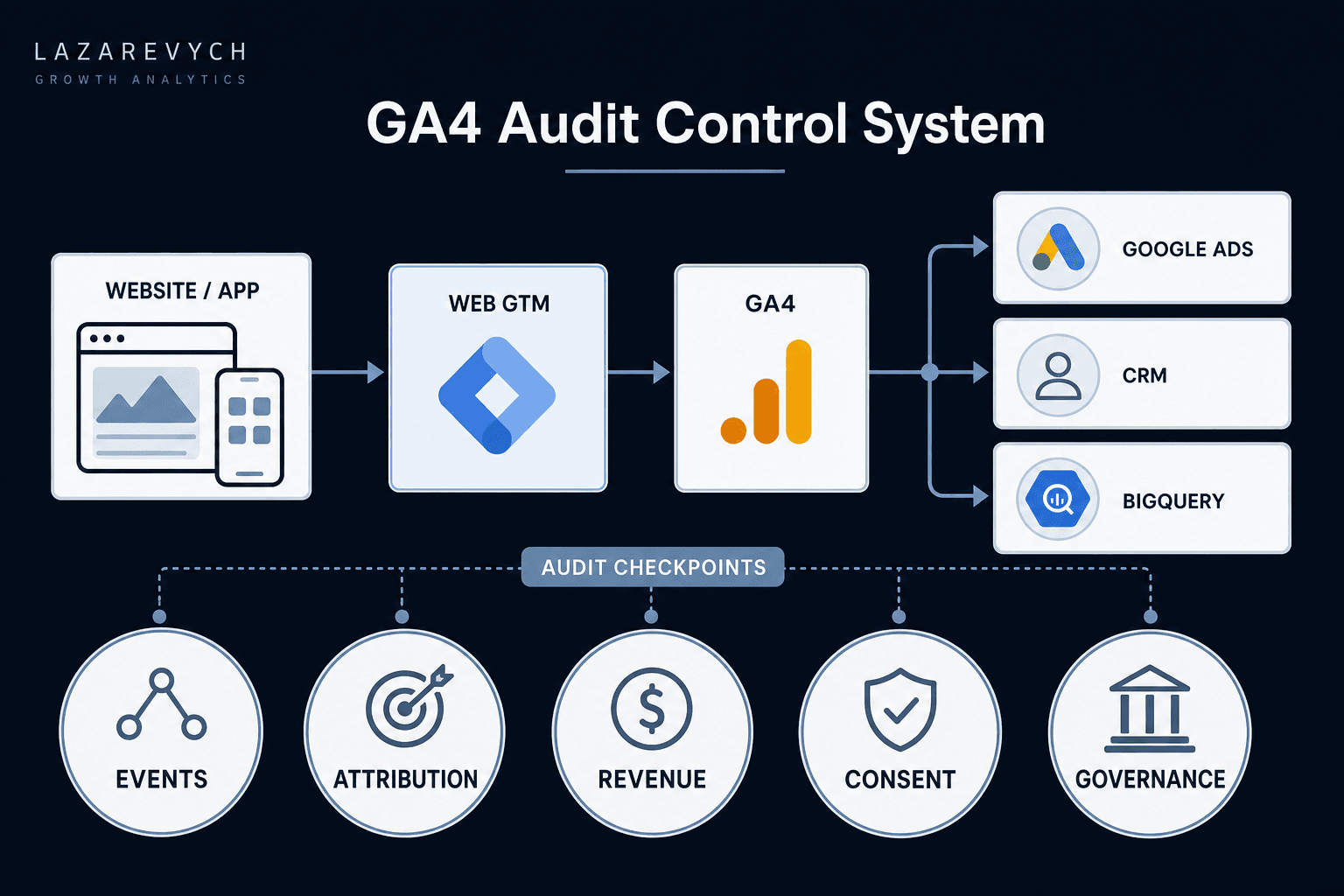
A GA4 audit checklist is a more appropriate starting point when the immediate problem is unclear event collection, attribution configuration or analytics data quality rather than server-side architecture.
Client-side vs server-side GTM
Most production designs use both layers. The browser still observes the interaction and often runs the web container. The server container adds a controlled processing and routing boundary; it does not eliminate the need for a correct browser event.
Table 1. Client-side vs server-side GTM at decision level
Swipe horizontally to view all columns →
Table 1. Client-side vs server-side GTM at decision level
Factor
Client-side GTM
Server-side GTM
Collection path
Browser sends requests to destination endpoints
Browser or source sends to a tagging server first
Control
Logic and payload remain exposed to browser conditions
Server can validate, transform and route approved fields
Browser dependence
Higher for tag execution and direct delivery
Reduced after the request reaches the server endpoint
Infrastructure ownership
Primarily site and container ownership
Adds endpoint, hosting, DNS, access and monitoring
Implementation complexity
Lower for simple, single-destination measurement
Higher because two containers and operations must agree
Validation
Browser request plus destination receipt
Browser, endpoint, server client, tag, destination and reconciliation
Maintenance
Site and tag releases
Adds hosting health, request cost and server templates
Best fit
Stable basic measurement with limited routing needs
Governed multi-destination signals with clear ownership
Scope of a real server-side GTM engagement
A reliable server side GTM implementation begins before the server container. The proposal should separate foundation repair from the server build so the client can see whether it is paying for new infrastructure, remediation of old tracking, or both.
Event and dataLayer readiness
Define the event name, trigger condition, required parameters, stable event or transaction ID, consent inputs, source owner and business meaning. For lead generation, decide whether the signal represents a form submission, qualified lead, opportunity or won revenue. For ecommerce, define purchase, refund and transaction identity behavior.
First-party endpoint and server container
The consultant should configure the tagging endpoint, domain or path, DNS or proxying, preview environment, production service, server container clients, destination tags and allowed request behavior. The infrastructure account and domain should normally remain client-owned, even if a managed provider operates the underlying service.
GA4, Google Ads and Meta destinations
Each destination needs its own contract. A server-side GTM for GA4 setup should preserve the intended event and parameter model rather than creating a second analytics taxonomy. Google Ads conversion tags and Enhanced Conversions require eligible first-party data, correct conversion actions and destination diagnostics. Google explains that enhanced conversions supplement existing conversion tags using hashed first-party customer data; they do not replace the underlying conversion definition. See the official Enhanced Conversions setup guidance.
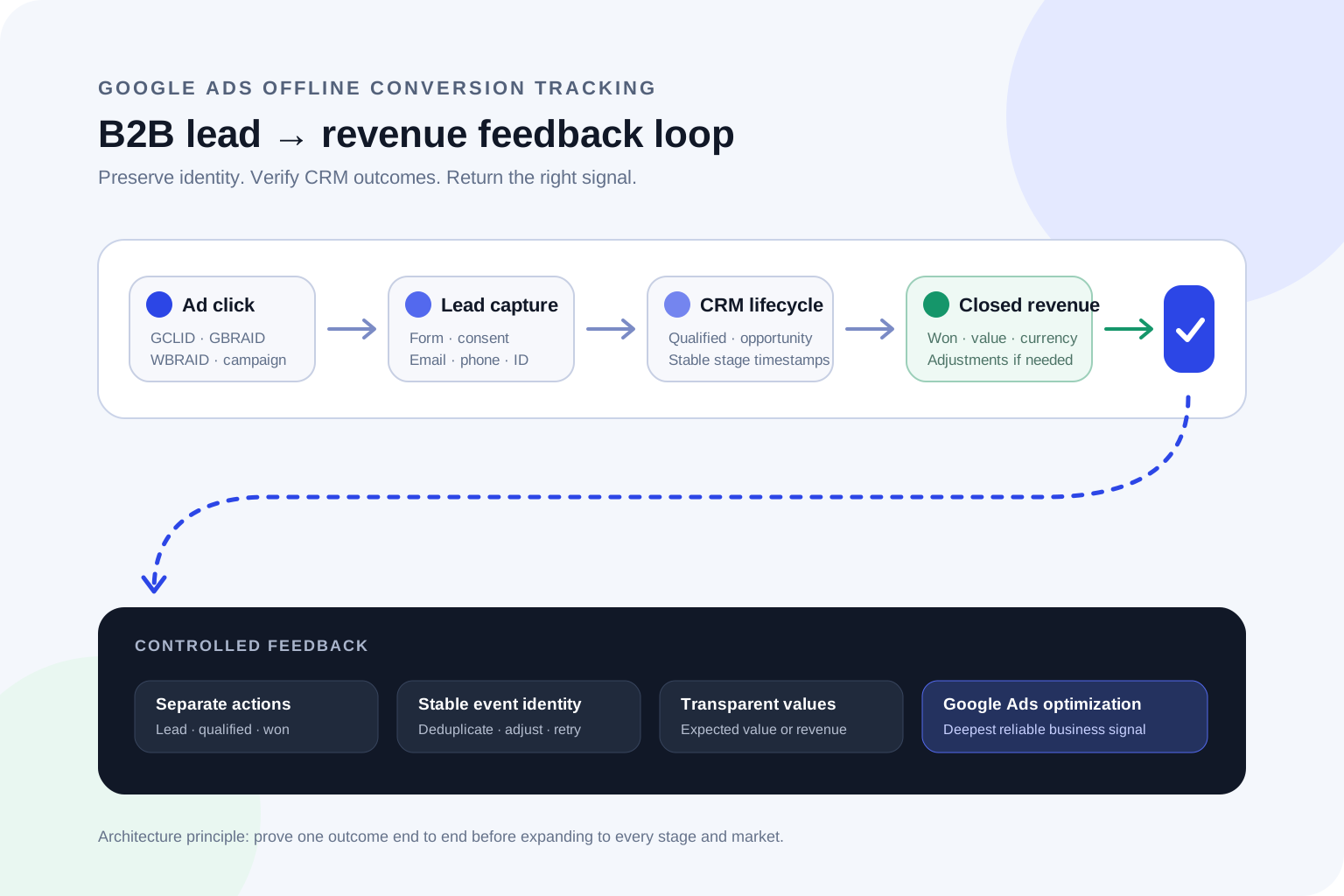
For B2B revenue signals, the implementation may need a separate CRM feedback path. The Google Ads offline conversion tracking guide covers that narrower identity, upload and bidding decision.
When Meta Pixel and Conversions API send the same conversion, the browser's eventID and the server's event_id must represent the same event. Meta documents this matching behavior in its Pixel and Conversions API deduplication guidance. The acceptance test should verify the identifiers and the resulting destination diagnostics, not simply confirm that both tags fired.
Consent, data minimization and governance
Server-side tagging is not a consent workaround. The approved consent model must set defaults before relevant tags act, update state after the user's choice and preserve that state through the server path. Google's Consent Mode documentation describes the technical sequence. The company and its legal advisers remain responsible for the policy, lawful basis, jurisdictions and data disclosures.
Validation, hosting and operational ownership
The engagement should test browser requests, server clients, tags, destination responses and business records for the same event scope. It should also name who owns provider billing, request limits, alerts, template updates, incident response, access review and changes after a website release.
Implementation process
A migration should move in vertical slices rather than switching every destination at once. Start with one high-value conversion, preserve a comparison period, validate it end to end and expand only after the variance and duplicate behavior are understood.
Implementation workflow
Completion is evidence, ownership and repeatable operation—not a published container
01
Diagnose
Trace current events, consent, identifiers and destination gaps.
02
Define
Agree event contracts, owners, allowed payloads and acceptance tests.
03
Build
Implement one high-value browser-to-server-to-destination slice.
04
Reconcile
Compare platform events with CRM, orders or billing for the same scope.
05
Operate
Hand over access, documentation, monitoring and a rollback path.
Release gate: the representative conversion passes the full path, consent behavior is documented, duplicates are controlled, destination diagnostics are clean and the variance to the chosen source of truth is understood.
Figure 2. A risk-controlled implementation sequence for new builds, audits and migrations.
A rollback plan matters. The team should know which browser tags remain active during validation, how duplicate delivery is controlled, which version can be restored and what conditions block a production publish. “The server preview looks correct” is useful evidence, but it is not a release gate on its own.
Deliverables and acceptance criteria
A proposal should list artifacts, tests and evidence. Access to the consultant's container is not a substitute for documentation or client ownership.
Table 2. Server-side GTM engagement deliverables
Swipe horizontally to view all columns →
Table 2. Server-side GTM engagement deliverables
Deliverable
What should be produced
Acceptance criterion
Evidence
Current-state audit
Event, tag, consent, identity and destination map
Material gaps have severity, owner and recommendation
Trace logs, screenshots and issue register
Measurement contract
Events, parameters, IDs, consent inputs and systems of record
Every scoped conversion has one documented definition
Versioned specification and test cases
Infrastructure
Endpoint, server container, hosting, access and release setup
Production route is client-owned, secured and observable
DNS, provider, container and access records
Destination build
GA4, Google Ads, Meta or other scoped tags and transformations
Approved payload reaches the correct property or account
Preview traces and platform diagnostics
Consent and deduplication
State mapping, event-ID rules and browser/server coordination
Defined states behave as approved and duplicates are controlled
Consent test matrix and duplicate checks
Reconciliation
Comparison of tracked events with CRM, order or billing records
Variance is quantified, explained and accepted for the same window
Record-level or aggregate reconciliation table
Handover
Runbook, owners, monitoring, costs, rollback and training
Internal owner can test, release and respond to a failure
Documentation and recorded handover
Server-side GTM cost: what actually drives it?
Separate three cost categories: implementation and engineering, hosting and infrastructure, and ongoing operation. A low monthly hosting price says little about the effort required to repair events, coordinate consent, build several destinations or reconcile commercial outcomes.
Table 3. Server-side GTM cost drivers
Swipe horizontally to view all columns →
Table 3. Server-side GTM cost drivers
Cost driver
What changes scope
Cost category
Implementation work
Clean migration versus rebuilding events and dataLayer
One-time engineering
Hosting
Managed provider, cloud configuration, regions and availability
Recurring infrastructure
Request volume
Events, script proxying, bots, debug traffic and peaks
Recurring infrastructure
Destinations
GA4 only versus Ads, Meta, TikTok, CRM and custom APIs
Build and maintenance
Templates and transforms
Standard tags versus custom clients, templates and redaction
Engineering and review
Consent requirements
One policy versus regions, CMP states and legal review
Design, QA and governance
QA and reconciliation
Tag checks versus multi-device record-level validation
Implementation and recurring QA
Ongoing maintenance
Internal owner versus monitored service and response commitment
Recurring operations
There is no defensible universal “average consultant price” because the deliverable may range from an audit to a multi-platform migration with custom infrastructure. Compare proposals against the same event scope, destinations, acceptance tests, documentation and operating ownership. A cheaper quote that excludes reconciliation is not the same product.
Stape vs Google Cloud Run at decision level
Managed hosting and client-owned cloud infrastructure can both support a valid server-side setup. The decision is primarily about operational responsibility, pricing behavior, procurement and the team's cloud capability—not which option sounds more technical.
As of September 1, 2026, Stape lists free and paid server GTM hosting plans with allowances based on incoming requests; confirm the current price, billing cadence and included features on the official Stape pricing page. Google's current Cloud Run setup guide estimates approximately $45 per month for each specified 1-vCPU, 0.5-GB server and recommends at least two instances to reduce outage-related data loss—approximately $90 per month before configuration-specific networking, logging or operational costs. Verify the assumptions in the official Google Cloud Run setup guide and current Cloud Run pricing.
Table 4. Managed hosting vs client-owned cloud
Swipe horizontally to view all columns →
Table 4. Managed hosting vs client-owned cloud
Decision factor
Managed sGTM hosting
Client-owned cloud
Best fit
Teams prioritizing fast setup and predictable operations
Teams with cloud standards, engineering ownership and custom needs
Operations
Provider handles much of scaling and platform maintenance
Client owns deployment, scaling, alerts and cost controls
Pricing behavior
Usually plan or request-volume based
Compute, memory, requests, network, logs and related services
Control
High at container level; provider controls infrastructure options
Greater infrastructure flexibility with greater responsibility
Handover
Client should own provider account, domain and containers
Client should own cloud project, billing, IAM and runbook
The technical guide on same-origin Cloudflare and Stape implementation goes deeper into one managed routing pattern. The hosting decision here should remain tied to ownership, resilience, volume and maintenance.
Server-side GTM consultant vs agency vs internal engineer
The best delivery model depends on the constraint. A specialist can be effective for diagnosis, architecture and a focused build. An agency can provide broader capacity or multi-market support. An internal engineer offers durable context and operational ownership when the work is frequent enough to justify the role.
Table 5. Consultant vs agency vs internal team
Swipe horizontally to view all columns →
Table 5. Consultant vs agency vs internal team
Factor
Consultant
Agency
Internal team
Best fit
Focused audit, design, migration or expert review
Broader rollout, parallel workstreams or managed support
Continuous change and long-term platform ownership
Speed
Fast when scope and access are clear
Capacity is higher; coordination may be heavier
Depends on priorities and current expertise
Ownership
Should transfer architecture, access and runbook
Must prevent provider-owned black boxes
Strongest continuity when roles are explicit
Engineering dependency
Client developers may implement dataLayer or DNS changes
May include engineering, but confirm exact skills
Direct access to product and release processes
Ongoing maintenance
Retainer, support block or internal handover
Often available as a managed service
Built into normal platform operations
Likely limitation
Single-person capacity and availability
Handoffs and diluted technical accountability
Hiring cost and limited external pattern exposure
Why existing server-side tracking breaks
Most failures are not caused by one exotic GTM setting. They happen at the boundaries between the browser, server, destination and business system.
No stable event identity: browser and server copies cannot deduplicate reliably.
Weak dataLayer: transaction, product, lead or consent fields are missing or change without a contract.
Wrong client claims the request: the server container parses an incoming event differently from the intended design.
Consent state arrives late or is dropped: destination behavior no longer matches the approved policy.
Destinations use different definitions: GA4, Ads and Meta receive events with the same label but different meaning.
Testing ends in Preview: nobody confirms receipt, diagnostics, attribution or reconciliation downstream.
Hosting has no owner: request limits, expired billing, DNS changes or template updates cause silent loss.
No change control: a website or CMP release breaks the collection path after acceptance.
When GA4 and Google Ads are the main disagreement, follow the narrower GA4 vs Google Ads conversion discrepancy diagnostic before assuming the server container is the cause. Counting rules, attribution, time zones and conversion-action configuration can create legitimate differences even when delivery works.
Questions to ask before hiring
Ask for concrete answers tied to your systems. These questions expose whether the proposal covers a complete server-side tracking service or only container configuration:
Which business outcome and decision justify this server-side layer?
What must be fixed in Web GTM or the dataLayer before migration?
Which events stay client-side, which route server-side and why?
Who owns the domain, hosting account, containers, templates and billing?
How will consent state be captured, forwarded and tested?
What event or transaction ID will control browser/server deduplication?
Which fields will each destination receive, transform or suppress?
How will GA4, Google Ads and Meta diagnostics be validated?
What source-of-truth data will be used for reconciliation?
What variance is acceptable, and how will unexplained differences be handled?
What monitoring, maintenance and incident response remain after launch?
What documentation, access and rollback procedure will the internal owner receive?
Red flags include guaranteed ROAS uplift, claims that server-side tagging makes tracking automatically compliant, promises to bypass all ad blockers, a consultant-owned hosting account, no consent test matrix, no event identity model, no reconciliation and a proposal that treats every existing browser tag as an automatic migration candidate.
Final decision framework
Move forward when four conditions are true: the business can name the conversion signal that matters; the current collection limitation is understood; the team accepts the hosting and maintenance responsibility; and the consultant can define evidence that proves the new path works.
Start with foundation repair when event definitions, consent, identity or CRM outcomes are unstable. Choose a focused consultant when the problem is bounded and specialist judgment is the constraint. Choose an agency for broader capacity or ongoing multi-market support. Build internal ownership when server-side measurement is a continuing production dependency rather than a one-time project.
For the wider architecture and consultant-selection context beyond the tagging layer, compare the Marketing Data Infrastructure Consultant guide. Server-side GTM should fit that system; it should not become a parallel measurement stack with its own definitions.
Scope the decision, ownership and validation before the build
If GA4, ad platforms and CRM do not reconcile—or server-side tracking requires architecture beyond a tag change—start by defining the source of truth, event contract and acceptance evidence.
Most businesses do not have a tracking problem because they lack data. They have a tracking problem because their data is fragmented, duplicated, blocked, delayed or disconnected from the systems where revenue is actually recorded. Google Analytics may show one number. Advertising platforms may show another. CRM data may not match either of them. Conversions…
A practical GA4 audit framework for finding tracking, attribution, revenue and data-quality problems — and prioritising the issues that can damage business decisions.