What Is Growth Engineering? Role, Systems, and Real-World Examples
A practical guide to the growth engineer role, the product and data systems behind measurable growth, and the signals that determine whether to hire the capability.
Growth engineering uses software, data, experimentation and automation to improve measurable outcomes across acquisition, activation, conversion, retention and revenue. Unlike growth marketing, which usually owns campaigns, audiences and messaging, the growth engineer builds or connects the product and data systems that make growth work measurable and repeatable.
The role looks different across business models. A product-led company may focus on signup, onboarding, monetization and retention. A sales-assisted business may need acquisition identity, CRM stages, lifecycle workflows and revenue feedback. In both cases, the job is to turn a defined opportunity into a production path that can be shipped, validated and improved.
What does a growth engineer do?
A growth engineer writes and connects the technical layers that let a business learn and act: event instrumentation, customer identity, APIs, CRM and revenue workflows, experimentation infrastructure, lifecycle automation, alerts, QA and documentation. The role is not defined by one programming language or analytics platform. It is defined by a commercial decision and the production evidence required to support it.
Growth engineering services are useful when the opportunity is sufficiently clear but execution crosses several teams or systems. A consultant may, for example, connect paid acquisition to qualified CRM outcomes, implement an exposure contract for an A/B test, automate a lifecycle handoff or build monitoring that detects a broken revenue-feedback path before bidding learns from stale data.
Three common growth engineering models
The term is used for several related operating models. Separating them makes the role easier to scope and prevents a company from hiring a product specialist for a CRM problem—or a data specialist for an onboarding build.
Table 1. Three common growth engineering models
Swipe horizontally to view all columns →
Table 1. Three common growth engineering models
Model
Typical constraint
Systems commonly built
Product growth engineering
Users sign up but do not activate, pay or return
Onboarding, paywalls, referrals, lifecycle triggers and experiments
Marketing and GTM engineering
Demand generation is disconnected from qualified outcomes
Lead capture, routing, CRM workflows, automation and revenue feedback
Growth infrastructure engineering
Teams cannot measure or operate experiments reliably
Instrumentation, identity, data transport, experiment infrastructure and monitoring
These models often overlap. The important distinction is not the job title; it is the growth constraint, the systems that must change and the evidence required to prove that the new path works.
Why analytics insights stall before implementation
A dashboard can show where performance changed. It does not create the event contract, repair identity, align CRM stages, implement a webhook, configure failure handling or decide who responds when the pipeline stops. Those dependencies explain why apparently simple findings often remain open for months.
An analytics audit identifies missing revenue attribution, but no team owns the identifiers required to connect sessions and CRM records.
Marketing wants value-based bidding, but the CRM has no stable qualification definition or feedback latency agreement.
Product wants to test onboarding, but exposure, eligibility and guardrail events are not consistently measured.
Operations wants automation, but retries, duplicate records, permission boundaries and failure ownership are unspecified.
Leadership wants AI-generated insights, but CAC, revenue and retention have different definitions across the systems feeding the model.
Definitions of growth engineering vary. In product-led companies, the role may focus on onboarding, activation, monetization and referral loops. In a sales-assisted or lead-generation business, it may focus on acquisition identity, CRM stages, offline outcomes, automation and revenue feedback. Both versions share the same logic: use engineering to improve the speed and reliability of measurable learning.
The work is therefore broader than “writing code that increases a metric.” A metric can rise because tracking duplicated an event, a cohort mix changed or a downstream guardrail deteriorated. Responsible growth engineering pairs delivery with measurement design, validation and interpretation boundaries.
Table 2. The contracts a production growth system needs
Swipe horizontally to view all columns →
Table 2. The contracts a production growth system needs
Contract
Question it resolves
Production evidence
Decision
What action should this system enable?
Owner, threshold, cadence and permitted action
Measurement
What would change if the system works?
Primary metric, guardrails, identity and time window
Delivery
Which systems and fields must connect?
Mappings, payloads, permissions and error paths
Validation
How will correctness be proved?
Controlled tests, reconciliation and duplicate checks
Ownership
Who operates and changes the system?
Monitoring, runbook, access and handover
Growth engineer vs growth marketer and adjacent roles
Growth engineering is cross-functional, but it should not become a vague label for every growth activity. Clear boundaries make it easier to scope a project and avoid buying the wrong service.
Table 3. Growth engineering compared with adjacent disciplines
Swipe horizontally to view all columns →
Table 3. Growth engineering compared with adjacent disciplines
Discipline
Primary responsibility
Typical output
Growth marketing
Acquire and nurture demand across channels
Campaigns, offers, audiences and channel plans
Marketing or GTM engineering
Make demand-generation operations scalable and connected
Lead routing, enrichment, CRM automation and campaign workflows
Growth analytics
Explain performance and decision evidence
Metrics, analysis, models and prioritized findings
Analytics engineering
Transform raw data into governed analytical models
Warehouse models, tests, lineage and documentation
Product engineering
Build durable product capabilities
Features, services, architecture and reliability
CRO and experimentation
Research friction and test prioritized hypotheses
Research, hypotheses, designs and experiment readouts
Growth engineering
Turn a growth decision into a measurable production path
Instrumentation, integrations, workflows, experiment enablement and monitoring
The boundaries overlap intentionally. For example, CRO and experimentation should define the customer problem and hypothesis; growth engineering can implement the exposure, outcome and delivery contracts required to run the experiment safely. Likewise, analytics infrastructure creates durable measurement foundations, while growth engineering uses those foundations to ship a specific operational capability.
What skills does a growth engineer need?
The role is hybrid by design. A strong growth engineer does not need equal depth in every discipline, but the person or delivery team must cover the complete path from commercial hypothesis to validated production outcome.
Table 4. Core growth engineering skills
Swipe horizontally to view all columns →
Table 4. Core growth engineering skills
Capability
Why it matters
Software and integration engineering
Ships product changes, APIs, workflows and system-to-system connections
Instrumentation and analytics
Defines events, identities and outcomes that make the change observable
Experimentation and statistics
Connects hypotheses to exposure, primary metrics and guardrails
Product and lifecycle thinking
Understands how acquisition, activation, conversion and retention interact
Commercial prioritization
Chooses work by expected decision value rather than technical novelty
Production ownership
Validates, monitors, documents and assigns responsibility after launch
In larger teams, these capabilities may be distributed across product, data, marketing and engineering specialists. The growth engineer is often the person who keeps the decision, implementation and evidence connected across those boundaries.
Common growth systems and implementation work
Once the opportunity is defined, the implementation should follow the constraint rather than a universal stack. Depending on the customer journey, the work may include the following domains.
Measurement and instrumentation
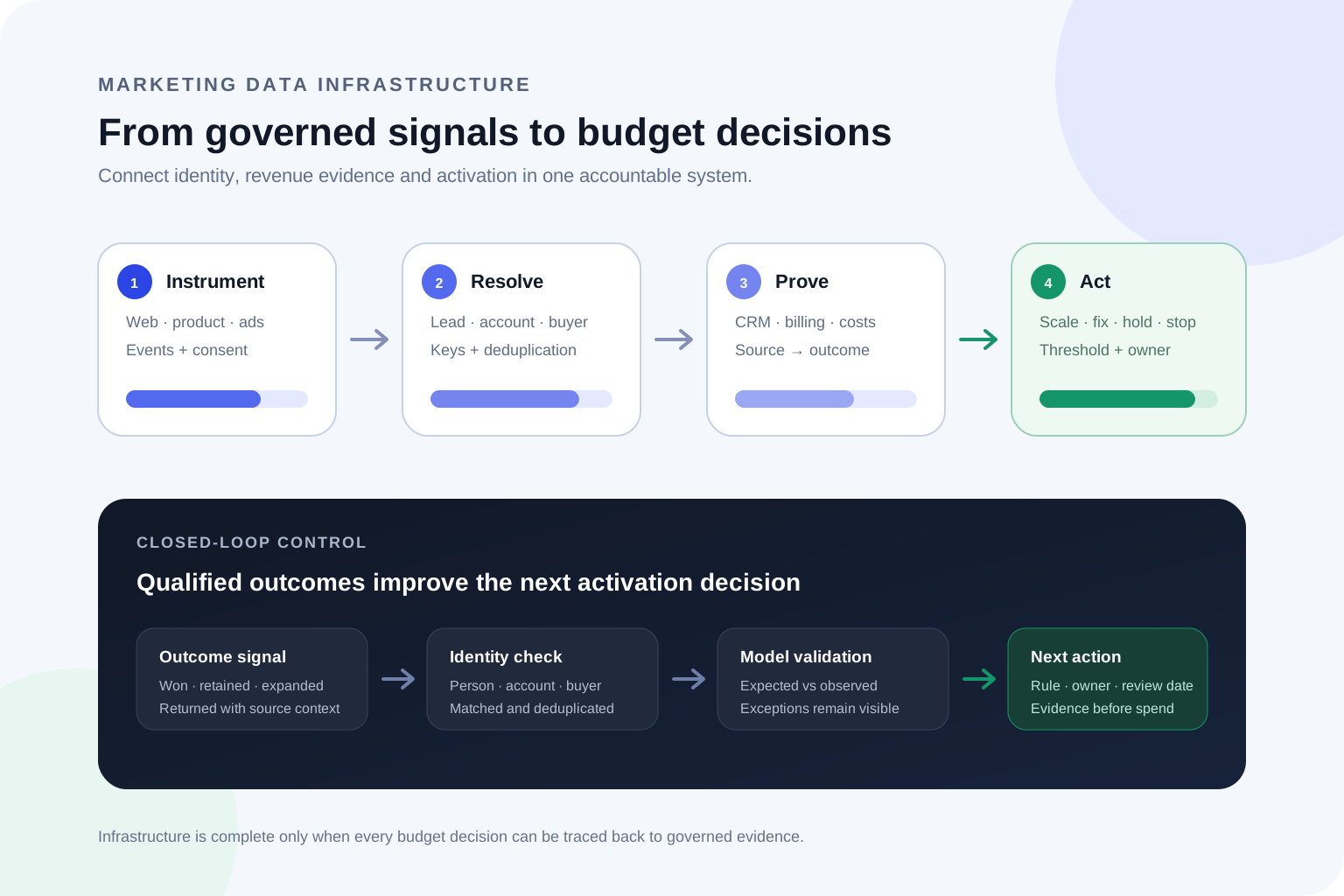
Define event taxonomy, data-layer fields, conversions, experiment exposure and outcome rules. The goal is not maximum event volume. It is sufficient, interpretable evidence for the decision in scope. For deeper collection and governance requirements, see the marketing data infrastructure consulting guide.
CRM, revenue and activation feedback
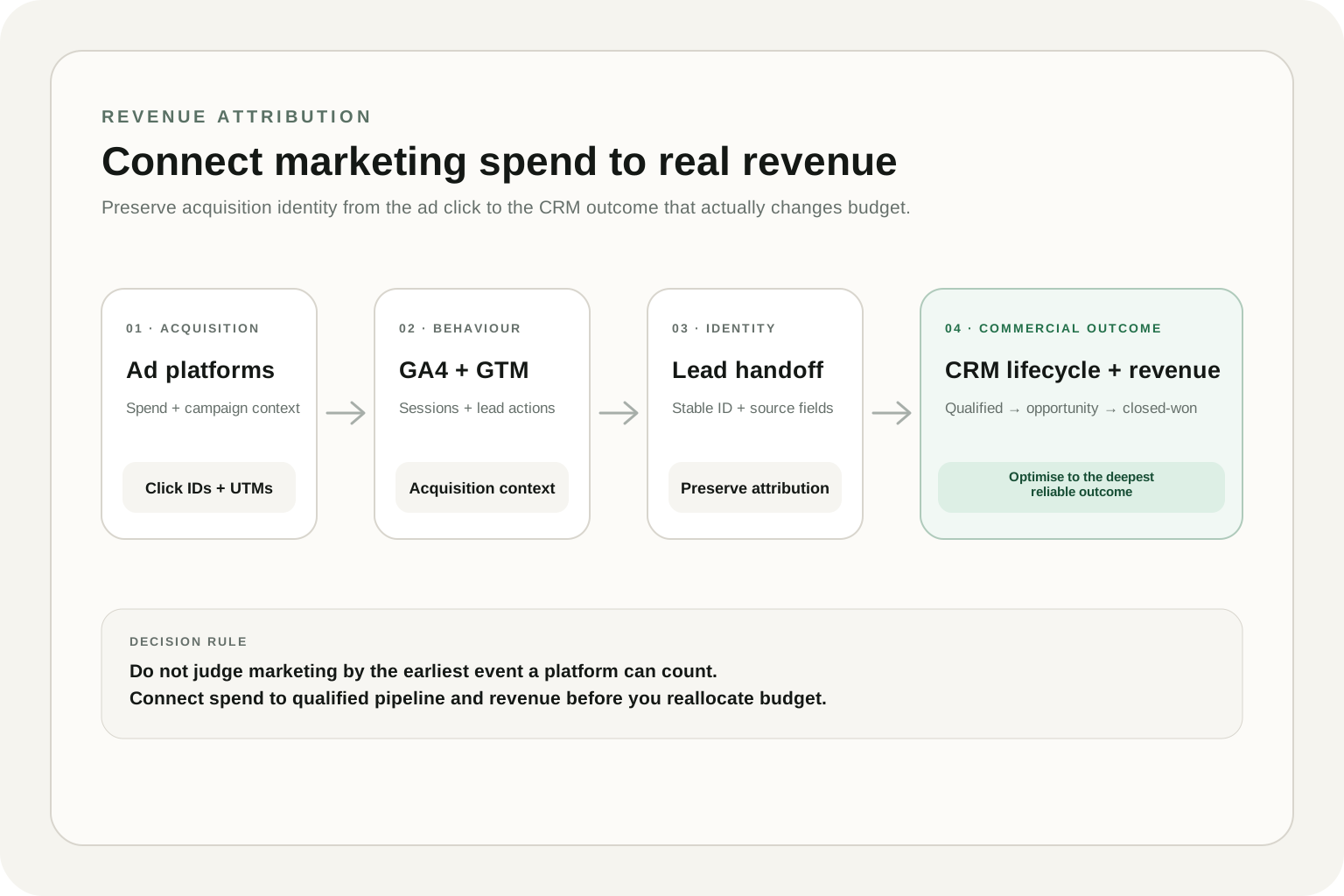
Preserve acquisition identifiers, normalize lifecycle stages and send qualified or revenue outcomes to the systems that can act on them. This can include CRM and offline conversion tracking rather than optimizing advertising to every form submission as if each lead had equal value.
Automation and lifecycle workflows
Implement routing, notifications, qualification handoffs and lifecycle triggers with explicit owners, retry behavior and observable failures. Automation is valuable when it removes repeatable operational delay; it is dangerous when it makes an undefined process run faster.
Experimentation enablement
Connect hypothesis, eligibility, exposure and outcome measurement so a shipped change produces trustworthy learning. Teams planning binary conversion experiments can use the A/B test sample-size guide and the A/B Test Calculator before committing engineering time.
Validation, observability and ownership
Test controlled records, deduplication, payloads, data freshness and failure paths. Document mappings and assign operational ownership. A pipeline that worked during launch but fails silently after a schema change is not a production-ready growth system.
How a growth hypothesis reaches production
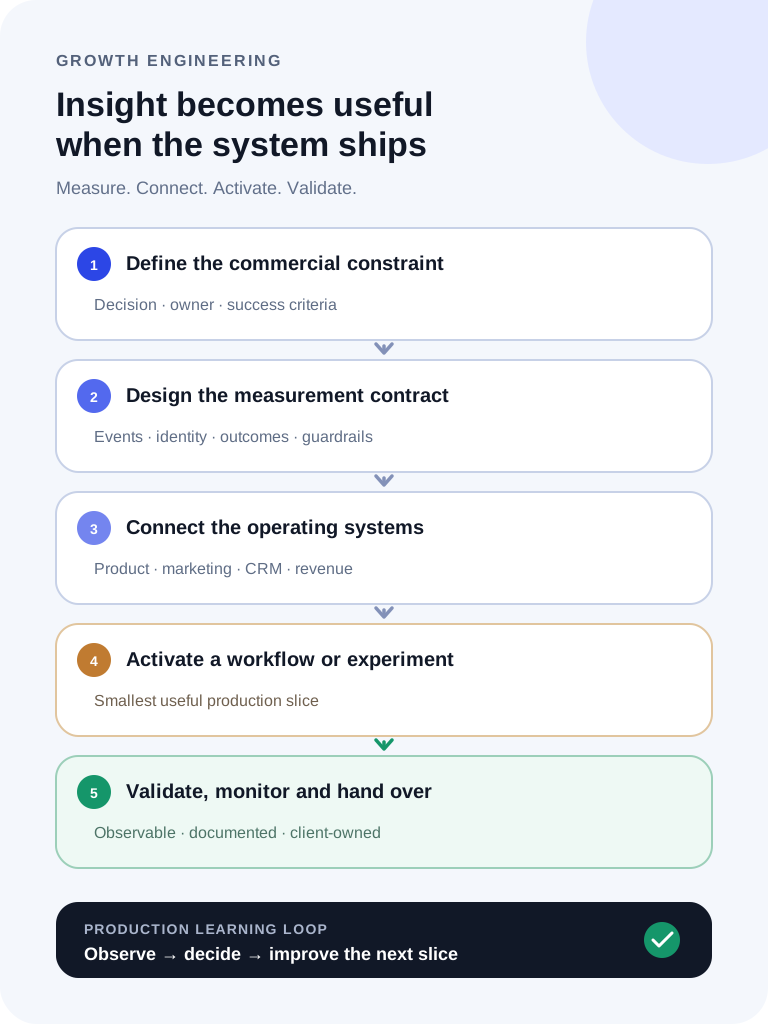
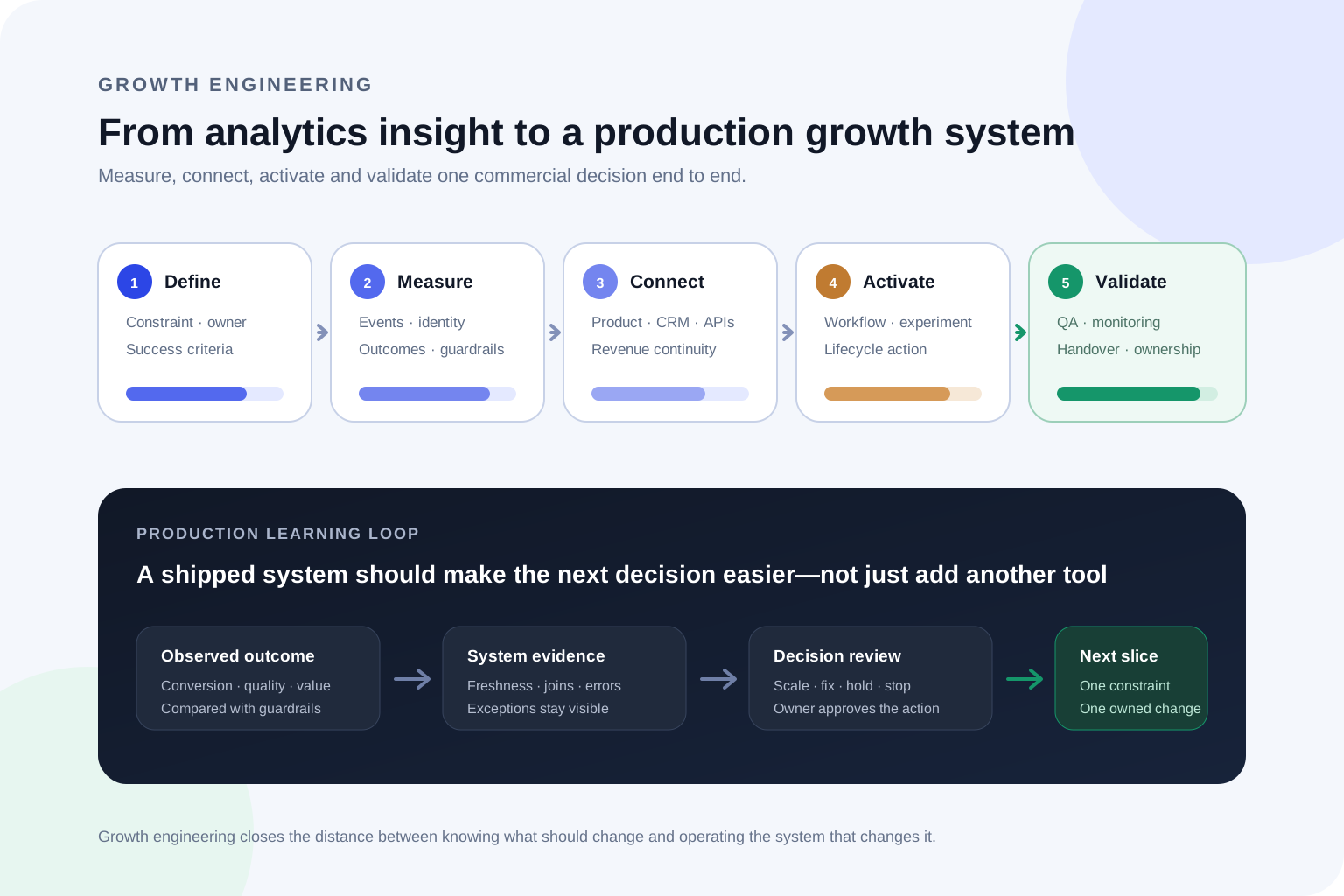
Reliable delivery moves in vertical slices. Instead of rebuilding an entire stack, prove one decision end to end—for example, paid click → qualified opportunity → revenue feedback, or trial signup → activation event → lifecycle action. The first slice should be valuable on its own and expose the dependencies that matter before the program expands.
Growth systems delivery loop
A decision becomes useful only after the operating path works in production
01 · Define
Commercial constraint
Name the decision, owner, success criteria and operating boundary.
02 · Measure
Evidence contract
Define events, identity, outcomes and guardrail metrics before building.
03 · Connect
System continuity
Move trusted data across product, marketing, CRM and revenue systems.
04 · Activate
Workflow or experiment
Ship the smallest automation, feedback loop or test that can change the decision.
05 · Validate
Production proof
Test payloads, deduplication, failures and the complete customer path.
06 · Operate
Owned learning loop
Monitor the system, document ownership and use results to choose the next change.
Production output: observable · documented · client-owned · ready to improve
The sequence is a decision aid, not a universal software lifecycle. The smallest useful implementation depends on the constraint and existing stack.
Define the decision and evidence: agree on the constraint, owner, primary outcome, guardrails and acceptable latency.
Build the smallest useful path: connect only the product changes, events, identities and workflows needed for the first measurable slice.
Validate reality, not responses: use controlled users or records, reconciliation and duplicate checks instead of treating a successful API response as proof.
Operate and learn: monitor failures, document the path, assign ownership and use observed outcomes to choose the next experiment or integration.
For teams that do not yet know which slice is most urgent, the AI Growth Infrastructure Assessment provides a structured first view of measurement, CRM, experimentation and decision-making maturity. It is a diagnostic starting point, not a substitute for record-level testing.
Two practical growth engineering examples
The same operating logic can support a product-led journey or a sales-assisted funnel. The systems differ, but both examples begin with a measurable constraint and end with validated production evidence.
Product-led SaaS: improving trial activation
Imagine a SaaS product where trial users create an account but many do not reach the first value-producing action. Before redesigning the entire onboarding experience, the team needs to know who was eligible, which steps they saw, whether the activation event is trustworthy and what happened after the first session.
A growth engineer can define exposure and activation events, implement a shorter onboarding variant, connect lifecycle triggers to verified user states and add retention or support guardrails. The result is not an assumed uplift; it is a production experiment that can show whether the change improved activation without creating a downstream problem.
Sales-assisted lead generation: connecting spend to revenue
Consider a lead-generation business where advertising platforms report clicks and form submissions, while the CRM records qualified opportunities, signed jobs, completed projects and revenue. Marketing can reduce cost per lead and still acquire customers who rarely close or generate weaker economics. The business problem is not a missing dashboard; it is the broken operating path between acquisition and commercial truth.
A growth engineering project can make that path operational:
preserve source and click identifiers at lead capture;
define CRM stages and the fields that represent qualified outcomes;
connect website, advertising, CRM and cost data through stable identity;
model cost per signed and completed outcome;
validate joins, duplicates and unattributed records;
return eligible outcome signals to advertising under agreed rules;
monitor freshness and failed feedback after launch.
An anonymized end-to-end marketing analytics implementation on this site connected paid acquisition with website leads, CRM qualification, signed jobs, completed projects and revenue. The system produced full-funnel source-to-revenue visibility, including observed costs of $833 per signed job and $909 per completed project. Those figures describe that engagement—not a guaranteed result of growth engineering services.
The implementation is related to, but broader than, connecting GA4, CRM and revenue attribution. Attribution explains how outcomes are assigned. Production growth engineering also covers the transport, workflow, failure handling, validation and ownership that keep the evidence usable.
Where AI belongs in growth engineering
AI can summarize a CAC increase in seconds. It cannot decide whether the increase is harmful without knowing whether those customers retain longer, contribute more margin or come from a deliberately expanded market. The same limitation applies to implementation: an agent can draft a query or integration, but it does not automatically know which system owns revenue, which consent state permits activation or who may approve a production change.
Useful AI-assisted steps include:
classifying leads or support text within defined categories;
summarizing deterministic anomalies and reconciliation failures;
drafting SQL, tests, mappings and documentation for human review;
prioritizing an investigation against explicit business thresholds;
helping operators navigate the relevant dashboards or runbooks.
AI should not silently redefine metrics, approve its own production access, hide uncertainty or take irreversible customer action without an appropriate control. The stronger the automation, the more explicit the data contract, validation boundary and human owner must become.
When to hire a growth engineering consultant
A company should consider growth engineering consultingwhen the implementation gap is commercially material and crosses multiple functions. Common triggers include:
The capability works best when the company has a functioning product or sales motion, enough traffic or records to observe the constraint, a decision that could change and a realistic way to ship. Before product-market fit, customer discovery and offer validation usually matter more than sophisticated experiment infrastructure. When growth delivery is continuous and central to the roadmap, an in-house engineer or team is usually the stronger long-term owner.
analytics findings remain unimplemented because ownership is split;
marketing optimizes to leads while CRM holds the real outcomes;
experiments are delayed by missing exposure or outcome measurement;
manual exports and spreadsheets control recurring customer workflows;
automation exists but failures, duplicates and permissions are opaque;
AI initiatives are planned on top of disputed or fragmented data;
the team needs a scoped build and handover, not permanent outsourced development.
Do not hire implementation support merely because a tool is fashionable. If the business question is unclear, start with diagnosis. If clean evidence already exists and the change belongs in the core product, the internal product team may be the correct owner. If the work is a defined cross-system growth capability, an external consultant can reduce coordination delay and leave behind a client-owned operating system.
A growth engineering agency may be appropriate when the roadmap requires sustained research, design, experimentation and engineering capacity across several workstreams. A specialist consultant is usually the tighter fit for one decision system, integration or implementation gap. In both cases, insist on explicit scope, production validation and ownership after handover.
Table 5. What a growth engineering engagement should deliver
Swipe horizontally to view all columns →
Table 5. What a growth engineering engagement should deliver
Deliverable
What it should prove
Constraint and success contract
The system is tied to a named decision, owner and measurable boundary
Instrumentation specification
Events, identities, outcomes and guardrails are explicit
Integration and workflow map
Systems, fields, permissions and failures are understood
Scoped production implementation
The agreed path works beyond a diagram or prototype
QA and monitoring evidence
Correctness, duplicates, latency and breakage can be detected
Documentation and handover
The client can operate and change the system after delivery
Growth engineering is the discipline of turning a defined growth opportunity into a measurable production system. It combines instrumentation, data integration, experimentation, automation, validation and operational ownership so a team can ship, measure and improve changes tied to business outcomes.
What does a growth engineer do?
A growth engineer builds and connects the technical systems behind measurable growth. Depending on the business model, that can include onboarding and activation flows, event tracking, experimentation, CRM and revenue integrations, lifecycle automation, monitoring and documentation.
What skills does a growth engineer need?
The role combines software or integration engineering, product and funnel analytics, experimentation, instrumentation, commercial prioritization and production ownership. No single person needs equal depth in every area, but the delivery team must cover the full path from hypothesis to validated outcome.
What are growth engineering services?
Growth engineering services are scoped implementation engagements that move analytics findings or growth priorities into production. Typical deliverables include an event specification, integration mappings, working automation or experiment infrastructure, QA evidence, monitoring, documentation and handover.
When should a company hire a growth engineering consultant?
Hire a growth engineering consultant when an important opportunity is understood but blocked by fragmented systems, missing instrumentation, engineering dependencies, manual workflows or unclear ownership. If the underlying problem is still unknown, begin with a growth audit before implementation.
How is growth engineering different from growth marketing?
Growth marketing usually owns acquisition, messaging, channels and campaign optimization. Growth engineering builds the technical measurement, integration, experimentation and automation systems that let those activities use better evidence and operate reliably across the customer journey.
How much does growth engineering consulting cost?
Cost depends on the number of systems, production access, identity complexity, implementation depth, QA requirements and monitoring scope. A focused integration or instrumentation project is smaller than a multi-system program involving CRM, warehouse, lifecycle automation and experimentation infrastructure.
Should you hire a growth engineering consultant, agency or in-house engineer?
A consultant fits a defined cross-system implementation or specialist decision gap. A growth engineering agency fits a broader program that needs sustained design, experimentation and engineering capacity. An in-house engineer is usually the best long-term owner when growth delivery is continuous and central to the product roadmap.
Can AI replace growth engineering implementation?
AI can accelerate research, classification, code drafting, anomaly explanation and documentation. It cannot independently define business truth, approve production access, resolve disputed metrics or own failures. Reliable AI-assisted growth systems still require explicit data contracts, validation and human accountability.
Ship the growth system your analytics says you need
Share the constraint, workflow or experiment backlog that is blocked between insight and implementation. The first step is to define the smallest measurable production path and the evidence required to validate it.
A buyer's guide to marketing data infrastructure consulting: audit scope, architecture, deliverables, cost drivers and evidence required before implementation.
A practical architecture for connecting ad spend, GA4 lead data and CRM lifecycle outcomes to closed-won revenue without relying on platform-reported conversions alone.