Growth Strategy
Maximum CAC: How Much Can You Afford to Pay for a Customer?
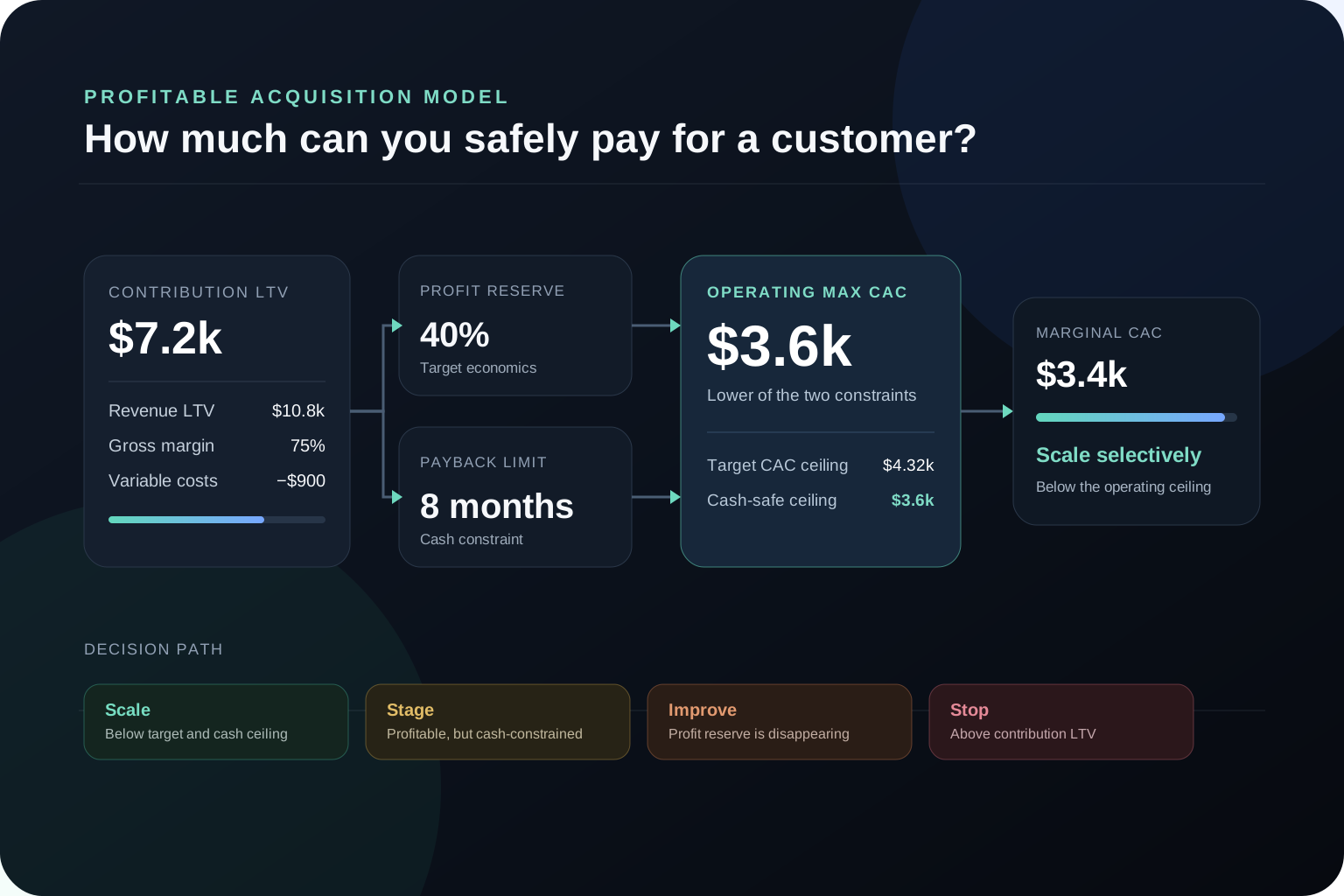
A commercial framework for calculating maximum profitable CAC, protecting payback and deciding whether acquisition spend is ready to scale.
Read articleShare
A practical framework for choosing the right CAC metric for paid media, company-level unit economics and the next increment of marketing spend.
A company can report a paid CAC of $240, a blended CAC of $310 and a marginal CAC of $420 in the same month—and all three numbers can be correct.
The problem begins when teams use one of them to answer a question it was not designed to answer. A paid-media team may defend budget using a platform-level CAC while finance is looking at fully loaded acquisition cost. Leadership may approve more spend from a healthy blended average even though the newest customers are already much more expensive.
The better question is not “What is our CAC?” It is:
Which acquisition-cost definition matches the decision we are making right now?
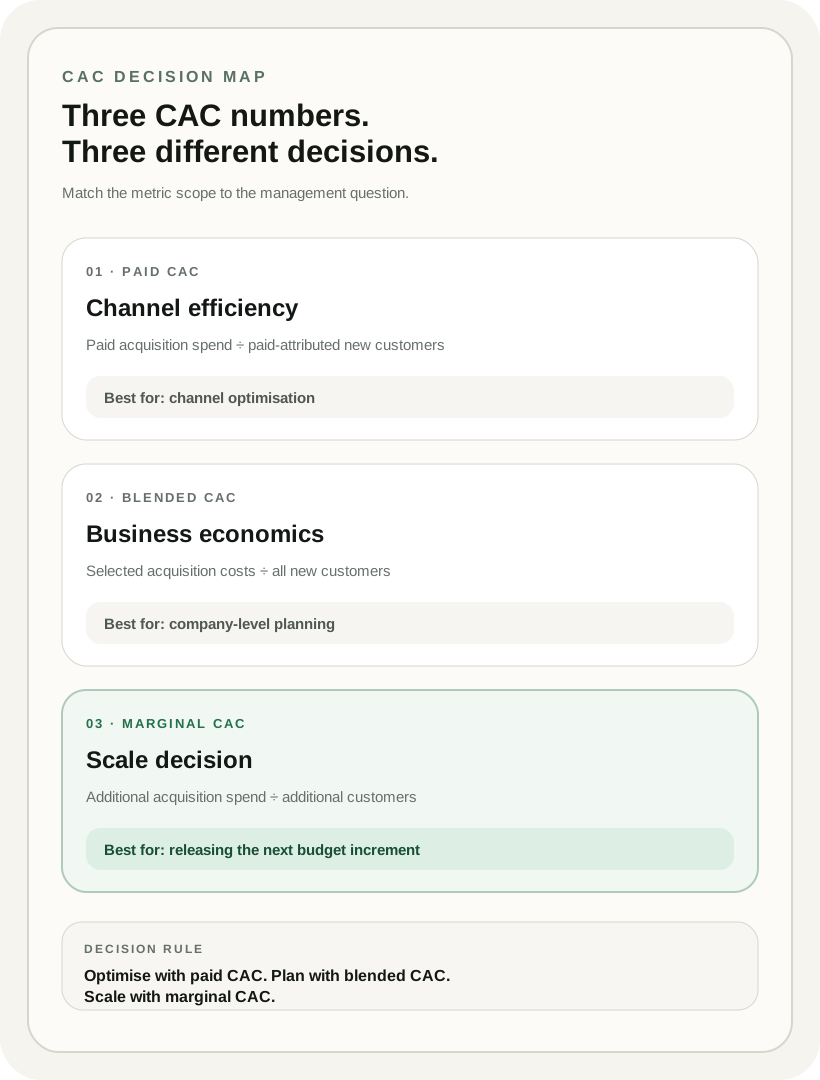
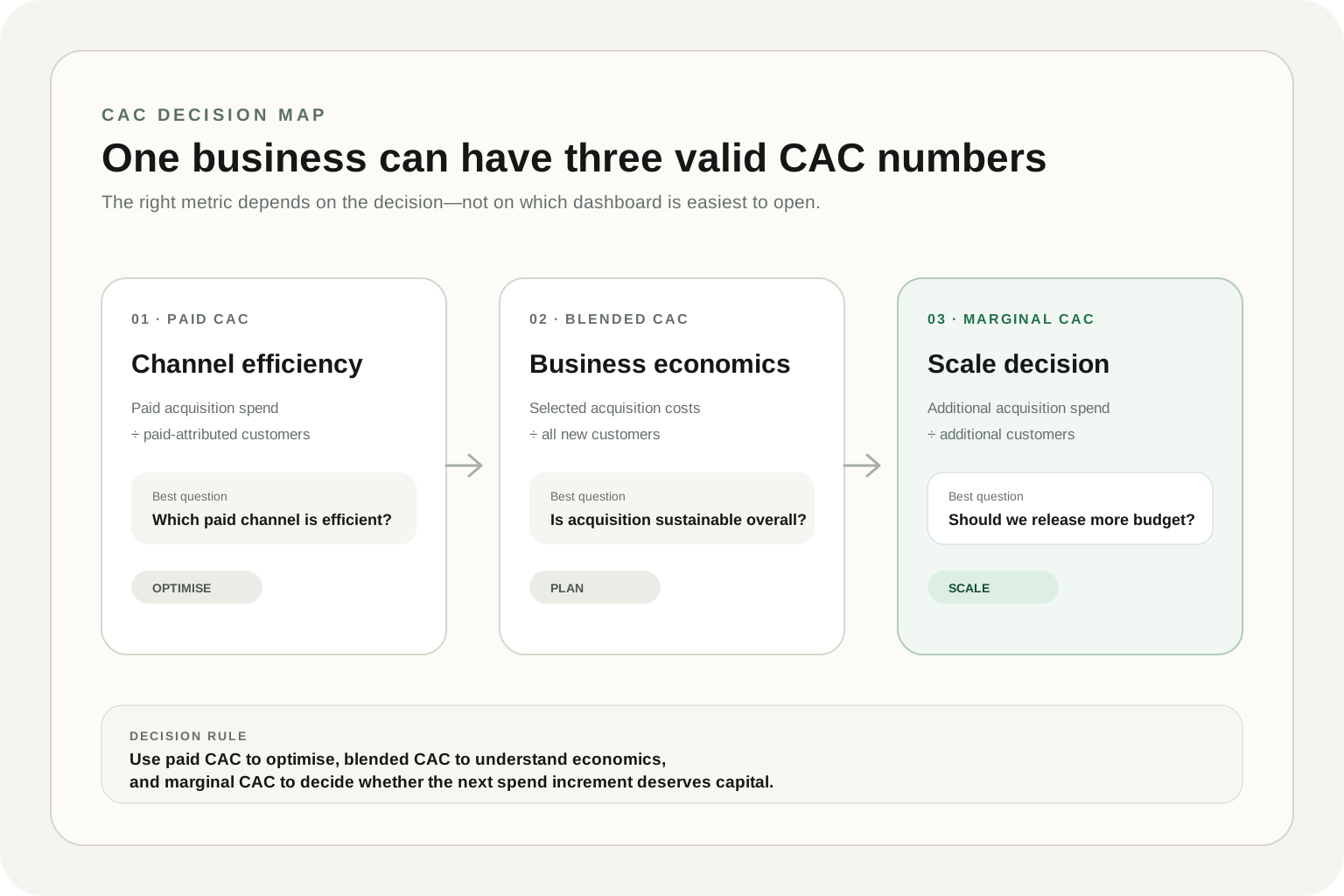
Use paid CAC to understand the efficiency of a defined paid acquisition scope. Use blended CAC to understand the economics of the wider acquisition system. Use marginal CAC to judge whether the next increment of spend deserves more capital.
Use the metric whose scope matches the decision. Mixing them can make paid media look efficient while the acquisition system is expensive—or make a scalable channel look worse than the company-wide average.
How efficiently are paid channels acquiring customers?
Scope
Paid acquisition spend ÷ paid-attributed new customers
What does the total acquisition system cost per new customer?
Scope
Acquisition costs across the selected scope ÷ all new customers
What did the next spend increment cost us?
Scope
Additional acquisition spend ÷ additional customers
CAC is a ratio. The numerator is acquisition cost. The denominator is newly acquired customers. Both parts can change depending on the decision.
Before calculating any version of CAC, document four things:
If those definitions change between reports, the apparent CAC movement may be a reporting change rather than a real change in acquisition efficiency.
| Metric | Typical numerator | Typical denominator | Best decision |
|---|---|---|---|
| Paid CAC | Defined paid acquisition spend | New customers attributed to paid acquisition | Channel and campaign efficiency |
| Blended CAC | Selected acquisition costs across the business | All new customers in the same scope | Company-level unit economics and planning |
| Marginal CAC | Incremental acquisition spend | Incremental customers created by that spend range | Whether to release the next budget increment |
Paid CAC is useful when the question is narrow: how much paid acquisition spend was required for each new customer credited to the paid channel or channel set?
Paid CAC = paid acquisition cost ÷ paid-attributed new customers
This view is useful for comparing campaign groups, markets and channel mixes, but the term is not a universal accounting standard. Some teams include only media. Others include agency, creative or sales development costs. That is why the report should show the definition beside the number.
Paid CAC can look excellent while the business-level acquisition system is expensive. For example, organic content, sales support, brand campaigns and tooling may be helping paid traffic convert without appearing in the paid CAC numerator.
Blended CAC broadens the view. It asks what the acquisition system costs per new customer across the chosen business scope rather than assigning every customer to one paid channel.
Blended CAC = selected total acquisition costs ÷ all new customers
This is often the better metric for budgeting, finance and company-level unit economics because it reduces dependence on platform attribution. But blended CAC can hide where the change came from. A stable company-wide average may combine improving organic acquisition with deteriorating paid media.
It can also move when channel mix changes even if no individual channel became better or worse. Use it as an economic summary, not as the only diagnostic.
Marginal CAC is the most important of the three when the decision is whether to increase marketing spend.
Marginal CAC = additional acquisition spend ÷ additional customers acquired
Suppose monthly acquisition spend rises from $50,000 to $65,000 and new customers rise from 150 to 180. The blended acquisition result at the new level may still look strong, but the newest $15,000 created only 30 additional customers. The marginal CAC of the increment is $500.
That $500 is the relevant number for asking whether the next budget tranche fits the company’s acquisition ceiling. The historical average includes customers acquired by cheaper earlier spend.
The article on forecasting CAC as marketing spend scales goes deeper into spend-response scenarios and staged budget releases.
Consider an illustrative month with the following acquisition data:
| View | Illustrative calculation | Result | What it tells you |
|---|---|---|---|
| Paid CAC | $60,000 ÷ 160 paid-attributed customers | $375 | Paid channel acquisition efficiency |
| Blended CAC | $75,000 total selected acquisition cost ÷ 200 customers | $375 | Economics of the broader acquisition system |
| Marginal CAC | $15,000 additional paid spend ÷ 60 additional customers | $250 | Economics of the newest spend increment |
In this example, paid and blended CAC happen to be identical even though the definitions are different. Marginal CAC is lower, suggesting the newest spend increment was efficient. A different month could show the reverse. The point is not that one metric is always higher; it is that each one describes a different scope.
| Question | Primary CAC view | Secondary check |
|---|---|---|
| Which paid channel is more efficient? | Paid CAC | Customer quality and downstream value |
| Is acquisition economically sustainable overall? | Blended CAC | Contribution LTV and payback |
| Should we increase the marketing budget? | Marginal CAC | Maximum profitable CAC and capacity |
| Why did CAC change this month? | All three | Channel mix, attribution and customer definitions |
If leadership wants one headline number, blended CAC is usually the most defensible economic summary. But a scaling decision should never stop there. Compare marginal CAC with the acquisition boundary the business can actually afford.
CAC becomes commercially useful only when it is compared with what the customer contributes and how quickly the acquisition cash returns.
The maximum profitable CAC framework shows how contribution LTV, profit requirements and payback constraints create an acquisition ceiling. The broader CAC, LTV and payback guide explains how to evaluate the three metrics together.
Use the Predictive LTV & Payback tool when retention and customer value constrain acquisition. Use the Marketing Budget & Growth Planner when the decision is how much additional spend to release under several CAC scenarios.
Paid CAC focuses on a defined paid acquisition cost and customers attributed to that paid scope. Blended CAC uses a wider acquisition-cost scope and all new customers in the selected business scope. Always document what costs are included.
Marginal CAC is the acquisition cost of the additional customers generated between two spend levels. It is often more relevant than blended CAC for deciding whether to scale spend.
Use blended CAC to understand current business-level economics, then use marginal CAC scenarios to test the next budget increment. Compare both with a maximum profitable CAC derived from margin, LTV and payback.
Yes. It can also be higher. The result depends on which costs and customers are included, the channel mix, organic contribution and the attribution method. The scopes must be comparable before interpreting the difference.
Share this article
Next step
Use the right CAC scope for the decision, then compare the next-customer economics with LTV, payback and a risk-adjusted marketing budget range.
Related
A commercial framework for calculating maximum profitable CAC, protecting payback and deciding whether acquisition spend is ready to scale.
Read article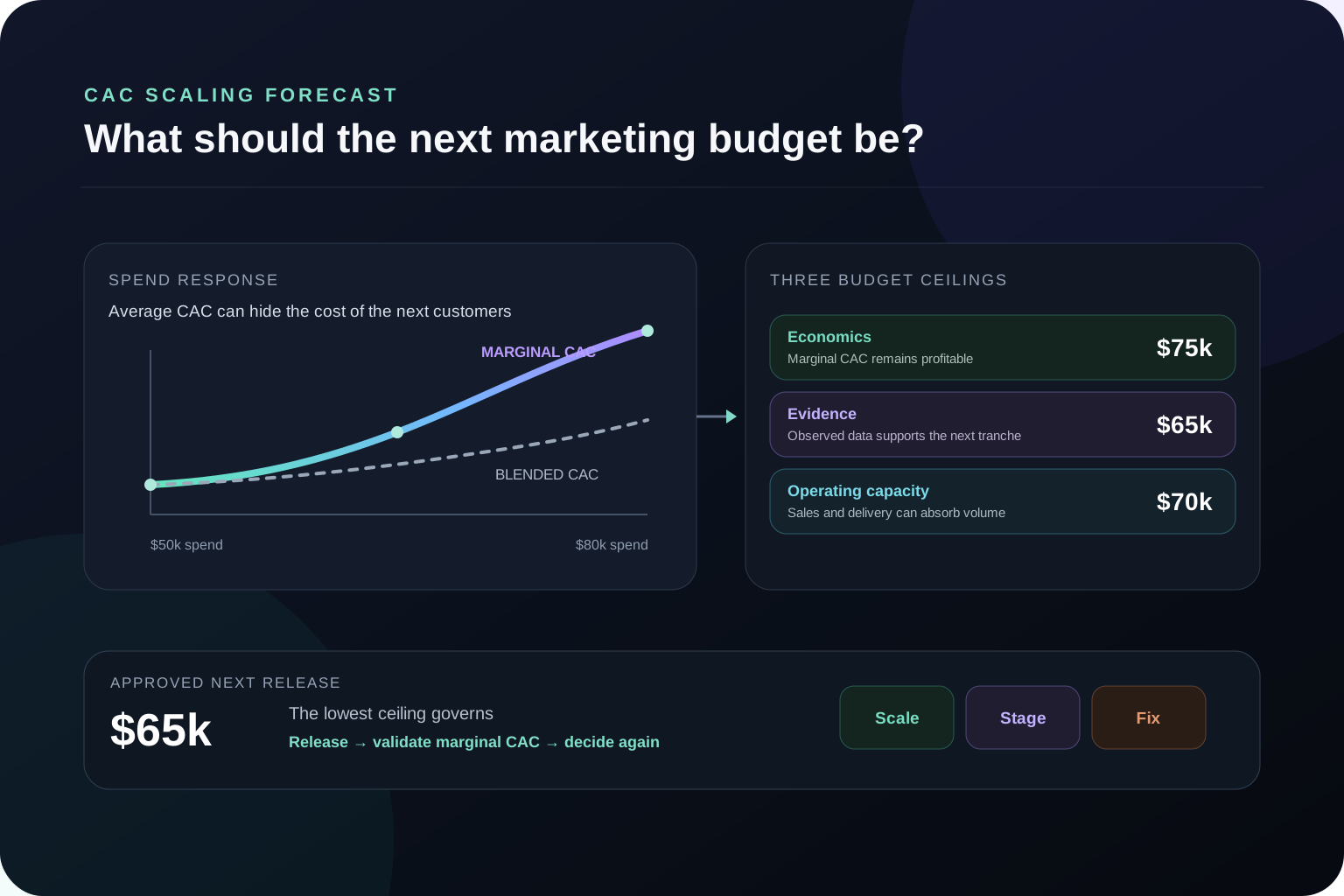
Forecast CAC at higher spend, separate average from marginal performance and release the next marketing budget only when economics, evidence and capacity support it.
Read article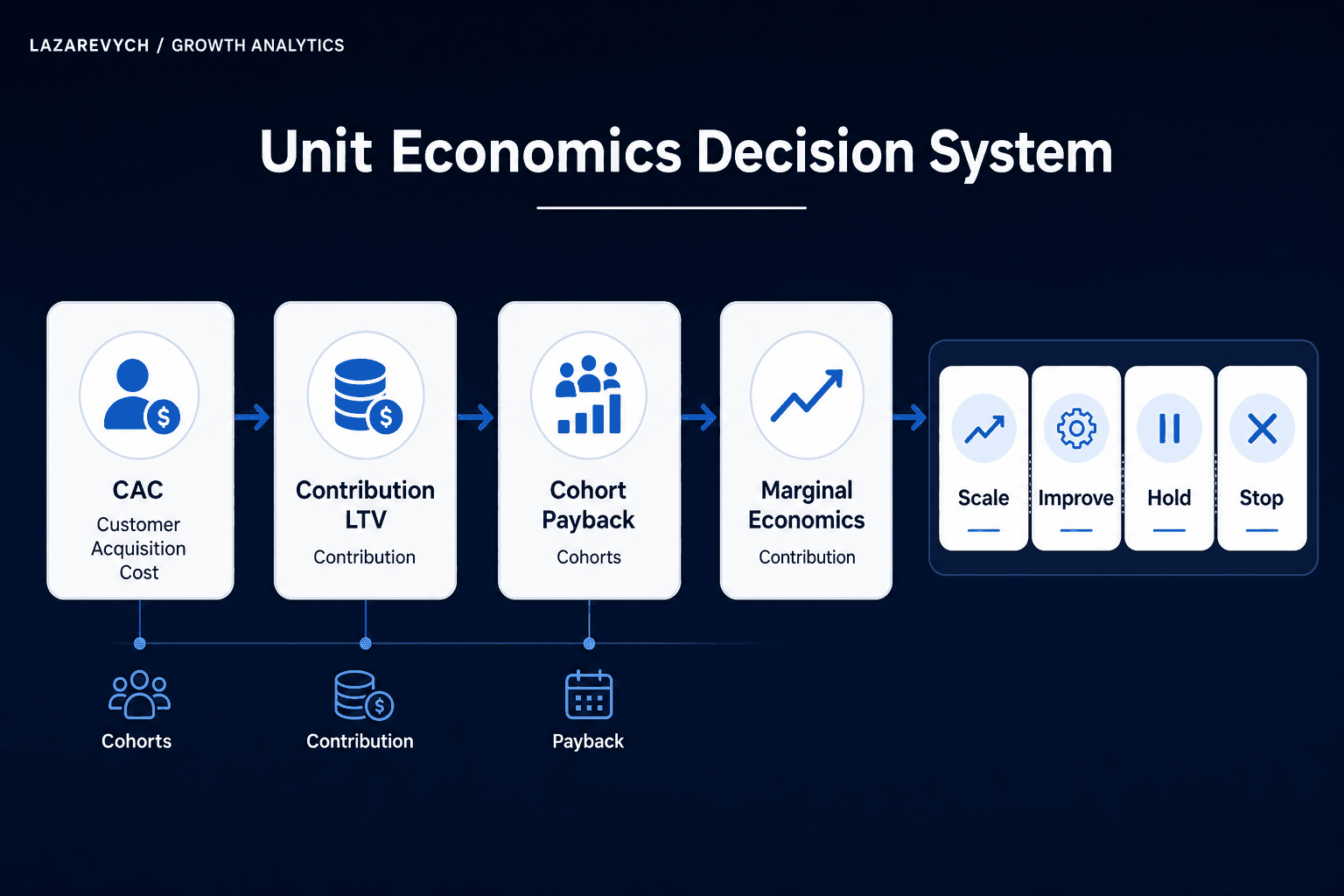
A practical guide to CAC, LTV and payback that separates decision-grade unit economics from misleading averages—so growth leaders know when to scale, investigate or stop spend.
Read article