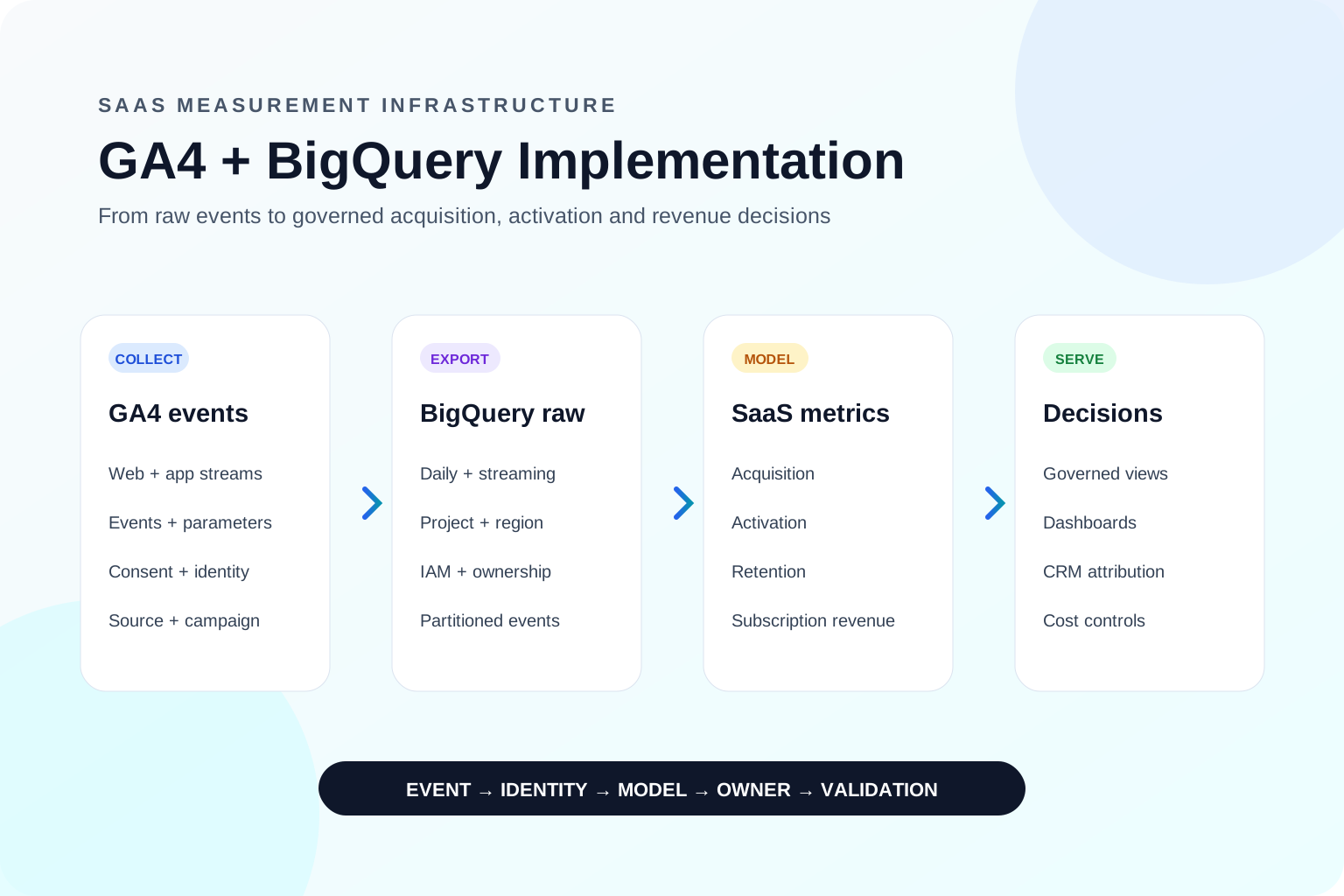
Web Analytics
GA4 + BigQuery Implementation Cost for SaaS
See GA4 and BigQuery implementation cost, scope, cloud-cost controls and the deliverables a SaaS team should receive before reporting begins.
Read articleShare
A buyer's guide to audit scope, cost drivers and deliverables for teams that need reliable marketing data before the next investment decision.
A marketing analytics audit cost should reflect the business decisions, systems and evidence being reviewed—not the number of screens in GA4. On this site, a Growth Analytics Audit starts from $1,000. Final scope depends on the number of systems, current tracking quality, channels, attribution complexity, data quality and how much implementation planning is required.
That starting point is not a generic market benchmark or a fixed quote. It is a transparent entry point for a diagnostic engagement that can span measurement, funnel, acquisition, CRM, data infrastructure and unit economics. The commercial question is whether the audit will reduce the risk of a more expensive decision.
Pay for a marketing analytics audit when unreliable data is blocking a meaningful decision: increasing media spend, changing bidding goals, rebuilding tracking, connecting a CRM, selecting an analytics platform, launching a warehouse or deciding which part of the funnel to fix. The output should show what is wrong, how the finding was proven, which decision it affects, what should change first and how the correction will be validated.
If the need is limited to checking one GA4 property, use a focused Google Analytics audit checklist first. If marketing, product, CRM and revenue systems disagree, a broader audit is usually more appropriate than treating GA4 as the entire source of truth.
If you prefer to begin with a product-led GA4 review before a consulting engagement, explore the marketing analytics platform.
The audit is not a promise that every platform will display identical numbers. Ads, GA4, product analytics, CRM and finance use different event times, identities, attribution rules and processing logic. The real deliverable is an evidence-based model of which system should answer each question and how acceptable differences will be monitored.
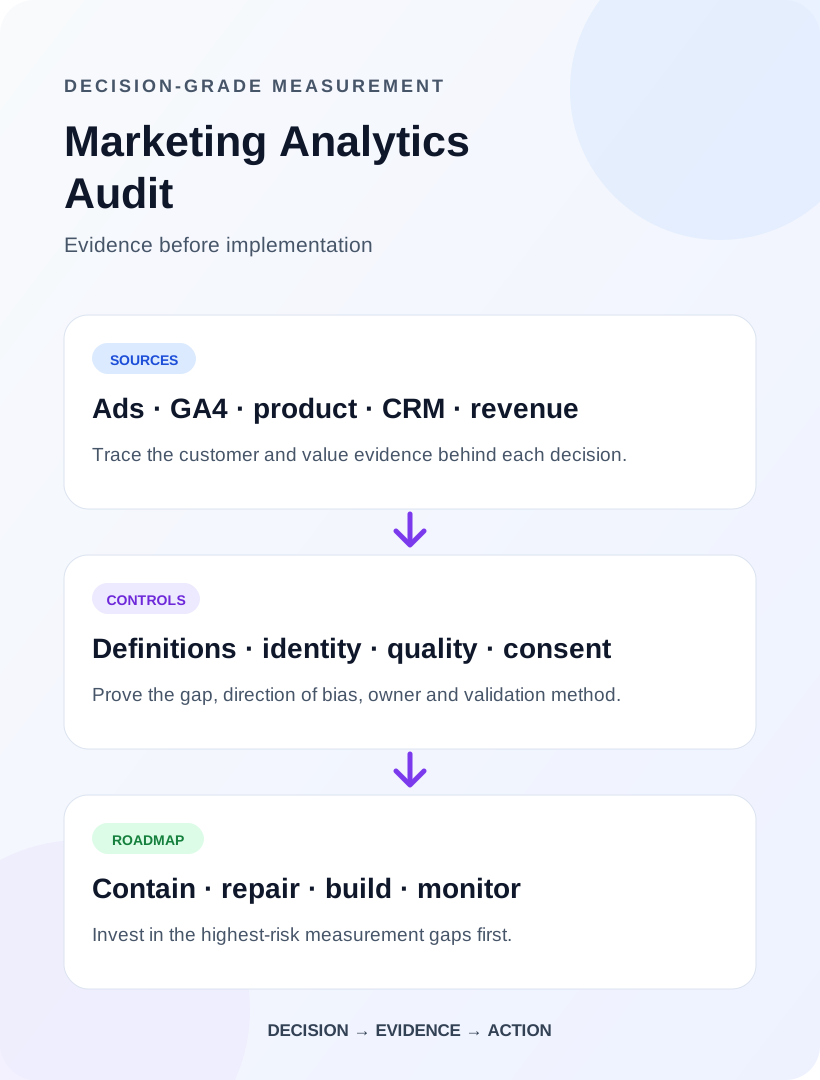
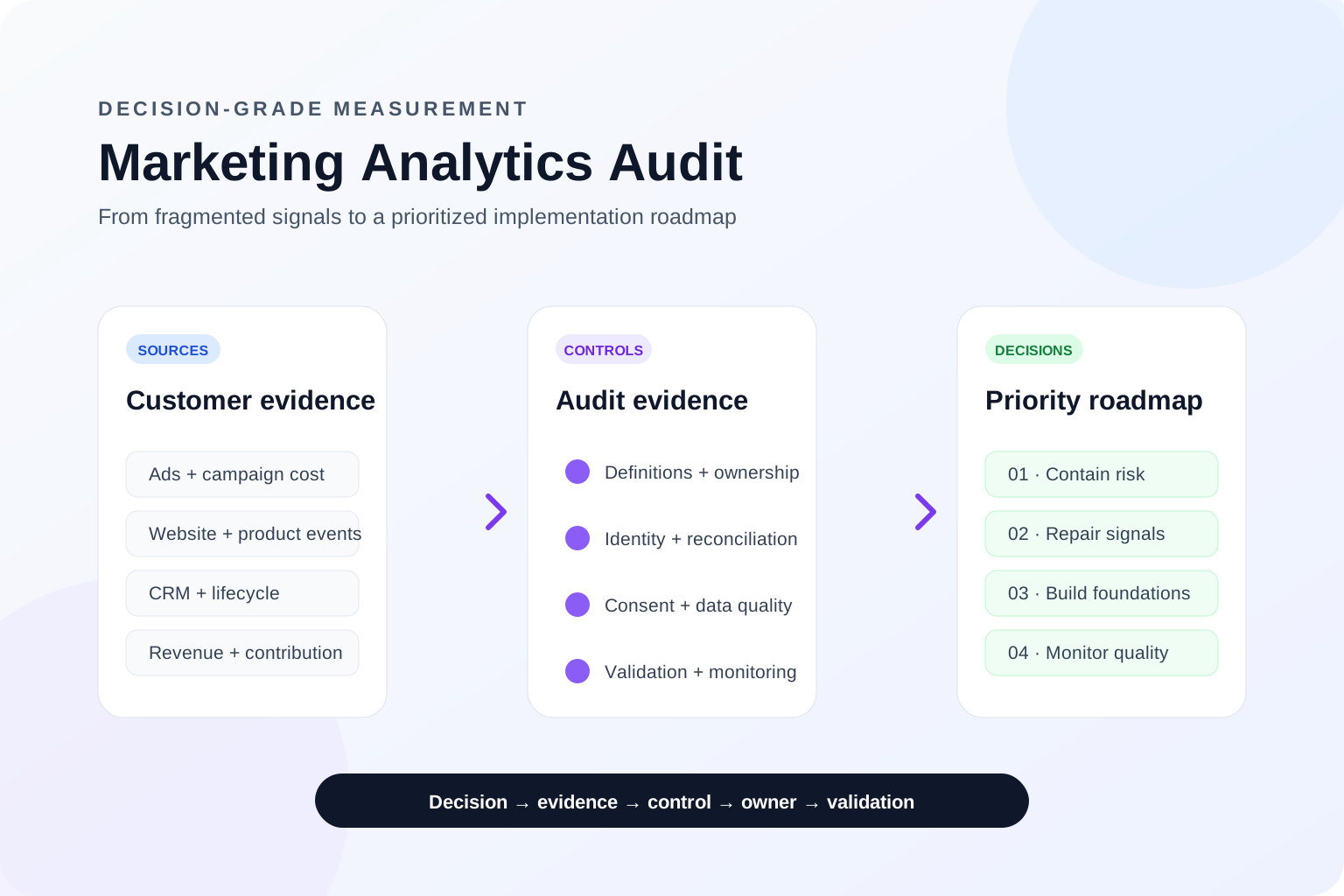
Decision-to-evidence audit model
A credible audit starts with the decision at risk, traces the evidence behind it, tests the controls, and ends with an ordered implementation roadmap.
Decisions
Budget, bidding, funnel, retention and forecasting questions
Evidence
Ads, website, product, CRM, billing and finance records
Controls
Definitions, identity, consent, reconciliation and ownership
Roadmap
Contain, repair, implement and monitor in business-risk order
A useful engagement begins with questions such as: Can paid-media bidding trust the current conversion actions? Can a lead be followed to closed-won revenue? Is ecommerce revenue deduplicated? Does product activation connect to acquisition source? Can finance reproduce the CAC used in the board report?
Only then should the consultant inspect tags, settings, event schemas, exports and dashboards. This order prevents the project from becoming a technically correct review of metrics nobody should use.
A fair cost comparison requires separating diagnosis, implementation and ongoing operation. These are different engagements with different outputs. The published starting points below are specific to this site and should not be read as universal industry ranges.
| Engagement | Published price | Primary output | Best fit |
|---|---|---|---|
| Growth Analytics Audit | Starting from $1,000 | Prioritized roadmap and executive presentation | Unclear problems; need to decide what to fix first |
| Analytics & Tracking Implementation | $2,500–$10,000+ | Validated and documented measurement system | Scope is agreed and the system needs to be built |
| Growth Analytics Partner | Starting from $2,000/month | Ongoing monitoring, analysis and decision support | The system and decisions require continuous ownership |
The full growth analytics consulting pricing page defines the current inclusions and commercial boundaries. A proposal should preserve them: diagnosis should not quietly become a promise to rebuild every system, and implementation should not begin before the highest-risk gaps are understood.
Scope should follow the customer and revenue journey. A B2B company may need ad click, form, CRM lifecycle, opportunity and closed-won evidence. Ecommerce may need product view, cart, checkout, purchase, refund and margin logic. SaaS may add activation, subscription, expansion, churn and cohort definitions.
| Workstream | What is tested | Evidence expected |
|---|---|---|
| Business and metric contract | KPIs, conversion definitions, value, CAC and ownership | Metric dictionary with inclusions, exclusions and owners |
| Collection | Data layer, GTM, GA4, consent, duplicates and parameters | Test journeys, network requests and destination records |
| Acquisition and attribution | UTMs, auto-tagging, conversion actions and source persistence | Campaign-to-outcome reconciliation and explained variance |
| CRM and revenue | Lead identity, lifecycle, offline outcomes, orders and refunds | Record-level match path from acquisition to business result |
| Product and retention | Activation, engagement, subscription and cohort definitions | Event schema and source-of-truth decision by question |
| Reporting and governance | Dashboard logic, access, monitoring, releases and documentation | Control plan, owners, acceptance criteria and cadence |
Product analytics does not belong in every scope. When it does, the question is not which interface looks better. The existing GA4 vs Mixpanel vs Amplitude comparison helps define whether acquisition reporting, behavioral analysis or both are required.
Marketing data infrastructure is the path that carries customer and campaign evidence from collection to activation and reporting. It can include the website or app, data layer, tag manager, analytics platforms, advertising destinations, CRM, billing, warehouse, transformations and dashboards. An audit should assess whether those layers form a controlled system or a chain of undocumented copies.
For GA4, BigQuery export can make raw event data available for SQL-based analysis and combination with external data. Google also notes that the exported data is owned by the customer and access can be managed with BigQuery permissions. Review the official GA4 BigQuery Export documentation. An audit should still verify schema use, identities, timezone, completeness, cost controls and ownership; a working export alone is not a governed model.
Server-side tagging may improve control and data quality by moving some processing out of the browser, normalizing requests and reducing exposed vendor code. It is not automatically required. Google’s server-side tagging guidance is useful for evaluating the tradeoff. The audit should recommend it only when the business case, consent design, maintenance ownership and data flow justify the extra layer.
| Layer | Control question | Failure signal |
|---|---|---|
| Collection | Does each core outcome fire once with required context? | Duplicates, missing parameters or premature triggers |
| Identity | Can sessions, leads, customers and orders be joined safely? | Overwritten source, duplicate contacts or unmatched revenue |
| Transformation | Are metric rules versioned and reproducible? | Dashboard-only formulas and conflicting KPI definitions |
| Activation | Do ad platforms receive intentional, validated outcomes? | Bidding optimizes toward shallow or duplicated conversions |
| Governance | Are consent, access, QA and owners documented? | Unreviewed releases, excessive access or silent breakage |
Consider a B2B team that sees 1,000 lead conversions in an advertising platform, 920 submitted-lead events in GA4, 610 matched CRM leads and 74 closed-won customers. It would be wrong to label the entire difference “lost tracking.” Some variance may come from attribution windows, consent, duplicates, spam, qualification rules and lifecycle timing.
Illustrative reconciliation
Counts alone do not prove a tracking error. The audit explains each transition and identifies which decision is unsafe.
1,000 reported lead conversions
Are conversion actions unique and tied to the intended bidding goal?
920 submitted lead events
Can the 8% variance be explained by consent, attribution or event logic?
610 matched lead records
Do persistent IDs connect form events to real contacts without duplicates?
74 closed-won customers
Can marketing source and acquisition cost be joined to final revenue?
The audit should quantify and classify those transitions. If 80 ad conversions are intentionally absent from GA4 because of measurement rules, that may be acceptable. If 310 GA4 leads cannot be joined to a CRM record because no persistent identifier exists, revenue attribution and offline optimization are materially limited.
For lead-generation businesses, Google describes enhanced conversions for leads as an upgraded offline import that can use hashed first-party data and click identifiers to improve conversion measurement. The official enhanced conversions for leads documentation explains current supported methods. The audit must still test consent, field quality, lifecycle rules, upload timing and diagnostic results.
Company revenue alone is a poor scoping variable. Two companies with similar spend can have radically different measurement systems. The proposal should state which of the following factors changes effort.
| Cost driver | Lower-complexity scope | Higher-complexity scope |
|---|---|---|
| Properties and markets | One site, language and GA4 property | Multiple brands, domains, apps, regions or currencies |
| Customer journey | One purchase or lead path | Several funnels, sales motions, payment or booking systems |
| Systems | Website, GTM and GA4 | Ads, CRM, product, billing, warehouse and BI joins |
| Evidence depth | Configuration and selected journey tests | Record reconciliation, cohort checks and data modeling review |
| Handover | Findings and prioritized recommendations | Metric contract, architecture, backlog, acceptance tests and enablement |
Access quality also matters. Missing permissions, undocumented vendor ownership and inconsistent stakeholder definitions consume time before analysis begins. A good discovery process names those dependencies before the fee is finalized.
The final document should allow an internal team or implementation partner to act without rediscovering the problem. Depending on scope, expect:
Priority should not equal the number of broken tags. One duplicated purchase signal used by automated bidding can be more important than twenty missing descriptive parameters. The finding register must explain direction of bias and the affected business decision.
Use an internal checklist when the stack is simple, ownership is clear and the decision at risk is limited. Choose an audit when the problem is disputed or crosses systems. Move directly to implementation only when the target architecture, definitions and priorities are already agreed.
The audit may reveal that new technology is unnecessary. It may also show that the next step is CRM revenue attribution, BigQuery, server-side measurement or product analytics. The Analytics Infrastructure service covers the build phase after diagnosis.
When the need extends beyond diagnosis into identity, pipelines, governance and activation, use the marketing data infrastructure consultant guide to define the broader architecture and operating model.
Reliable measurement also improves later planning. Once CAC, conversion and revenue inputs are validated, use the marketing budget calculator to model a target and scenarios. When the debate is metric scope, the blended CAC vs paid CAC guide separates company-level, paid-channel and marginal acquisition decisions.
Ask each provider to explain the audit boundary before discussing the slide deck. A credible answer should identify the decision, sources, evidence method, dependencies, output and what is explicitly excluded.
Warning signs include guaranteed data accuracy, unexplained benchmark percentages, a price with no named systems, a report with no access to real records, or a long finding list with no business-risk priority.
On this site, a Growth Analytics Audit starts from $1,000. The final fee depends on the number of websites, products, channels and markets; the quality of current tracking; CRM and attribution complexity; data-infrastructure depth; and the evidence and handover required. The starting price is not a fixed quote for every stack.
A credible scope should connect business decisions to measurement evidence. It commonly includes GA4 and GTM, campaign and conversion definitions, consent and data quality, CRM and revenue attribution, product analytics where relevant, BigQuery readiness, reporting logic, ownership, and a prioritized implementation roadmap.
No. A GA4 audit focuses on one important measurement system. A marketing analytics audit may include GA4, but it also examines advertising platforms, tag management, CRM, billing or ecommerce records, product events, warehouse readiness, reporting definitions and the decisions those systems support.
Diagnosis and implementation should be separated unless the proposal explicitly combines them. On this site, the Growth Analytics Audit produces a prioritized roadmap and executive presentation. Analytics and Tracking Implementation is a separate engagement priced at $2,500–$10,000+, depending on scope.
Expect an executive summary, evidence-backed finding register, measurement and source map, risk and effort prioritization, metric definitions, implementation roadmap, validation criteria, owners and a presentation or working session. A list of screenshots without decision impact and next actions is not enough.
It is most valuable before a large budget increase, analytics rebuild, CRM or warehouse project, new market launch, attribution-model change, or when Ads, GA4, CRM and finance disagree. If the decision at risk is small and the stack is simple, an internal checklist may be enough.
A strong audit does not make every number identical. It makes differences explainable, assigns the right source to each decision and gives the team a practical order of operations. That is the point of paying for diagnosis before committing more budget to dashboards, platforms or implementation.
Share this article
Diagnose before you rebuild
Share the decisions your team cannot trust, the systems behind them and the scale of the next budget or implementation. The audit should define the smallest credible path from uncertainty to validated measurement.
Related
See GA4 and BigQuery implementation cost, scope, cloud-cost controls and the deliverables a SaaS team should receive before reporting begins.
Read article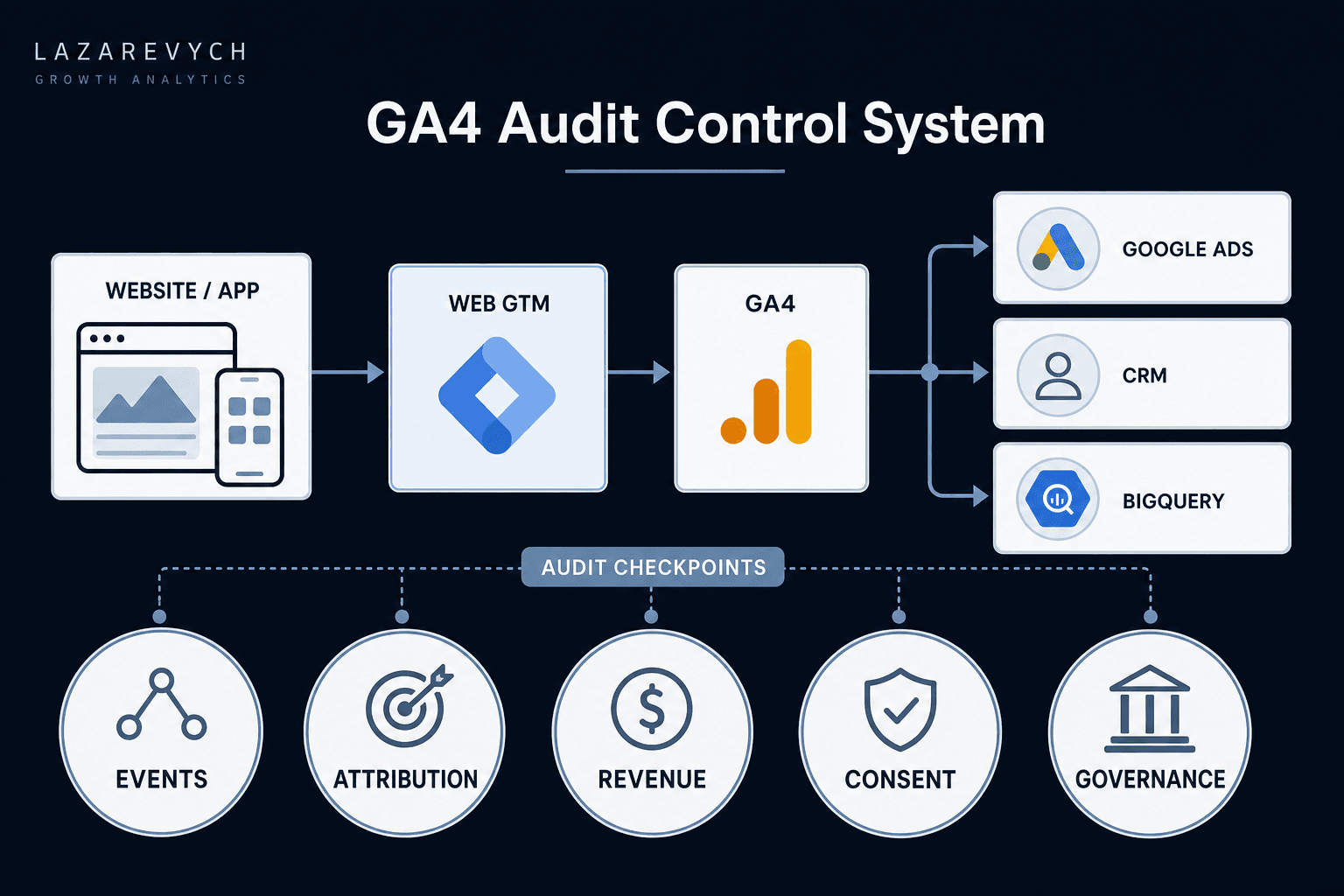
A practical GA4 audit framework for finding tracking, attribution, revenue and data-quality problems — and prioritising the issues that can damage business decisions.
Read article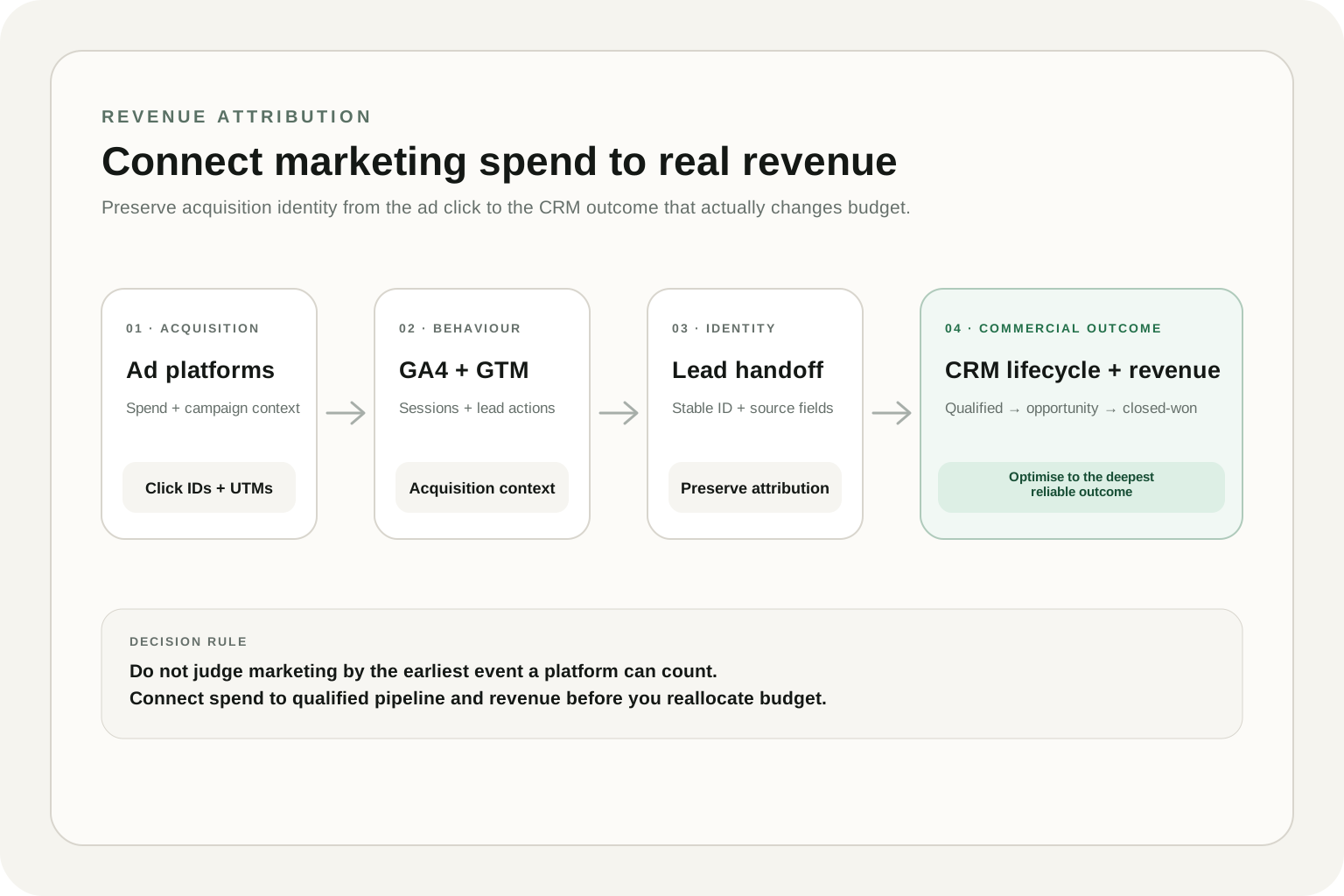
A practical architecture for connecting ad spend, GA4 lead data and CRM lifecycle outcomes to closed-won revenue without relying on platform-reported conversions alone.
Read article