SaaS Unit Economics Consultant: CAC, LTV & Payback Before Scaling
A commercial guide for SaaS leaders who need a decision-grade model—not another optimistic LTV:CAC ratio.
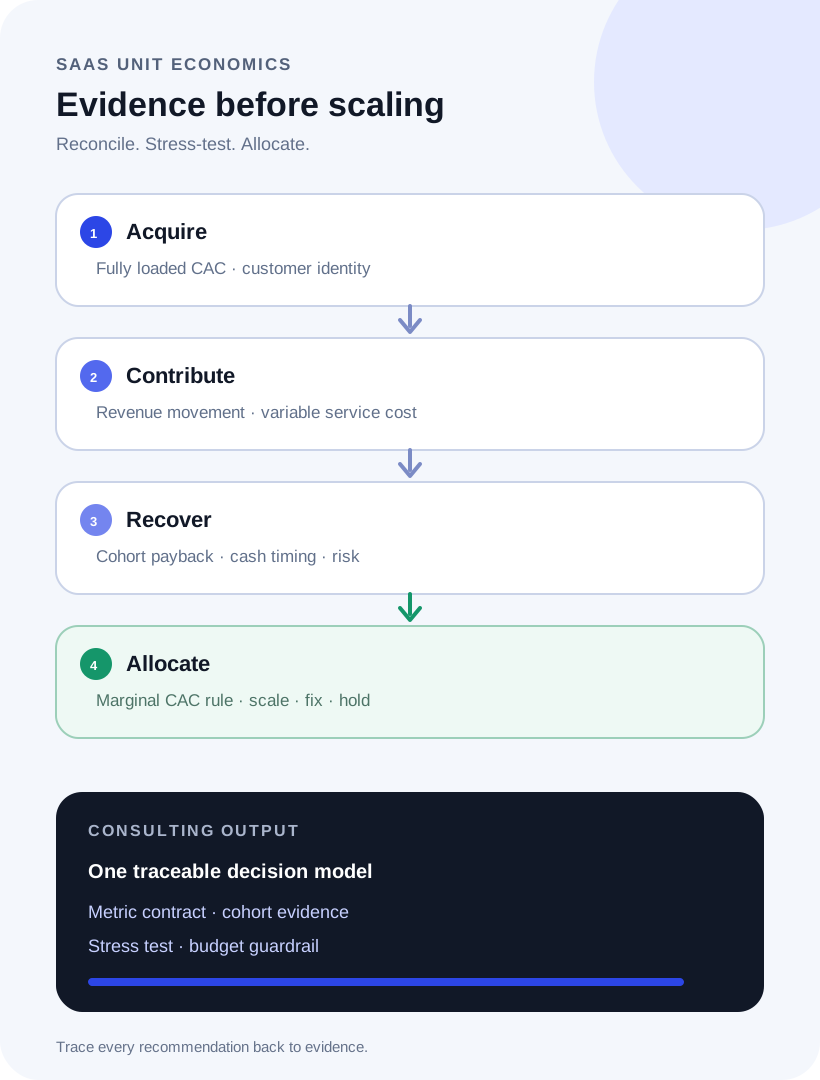
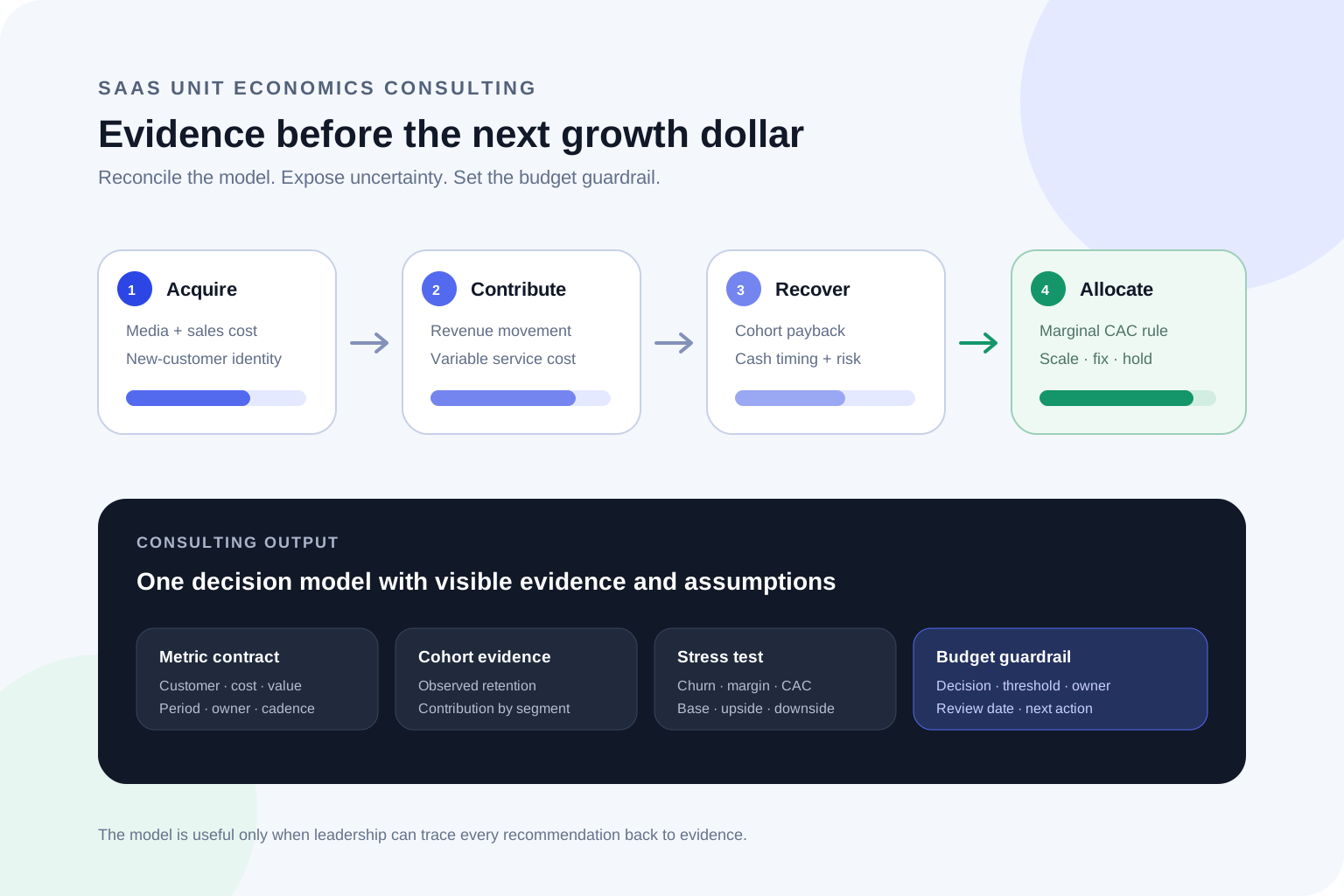
A SaaS unit economics consultant should turn acquisition, billing, retention and cost data into a model leadership can use to allocate capital. The work is not complete when CAC, LTV and payback appear in a spreadsheet. It is complete when their definitions reconcile, uncertainty is visible, weak segments are not hidden by averages, and the next budget decision has an explicit guardrail.
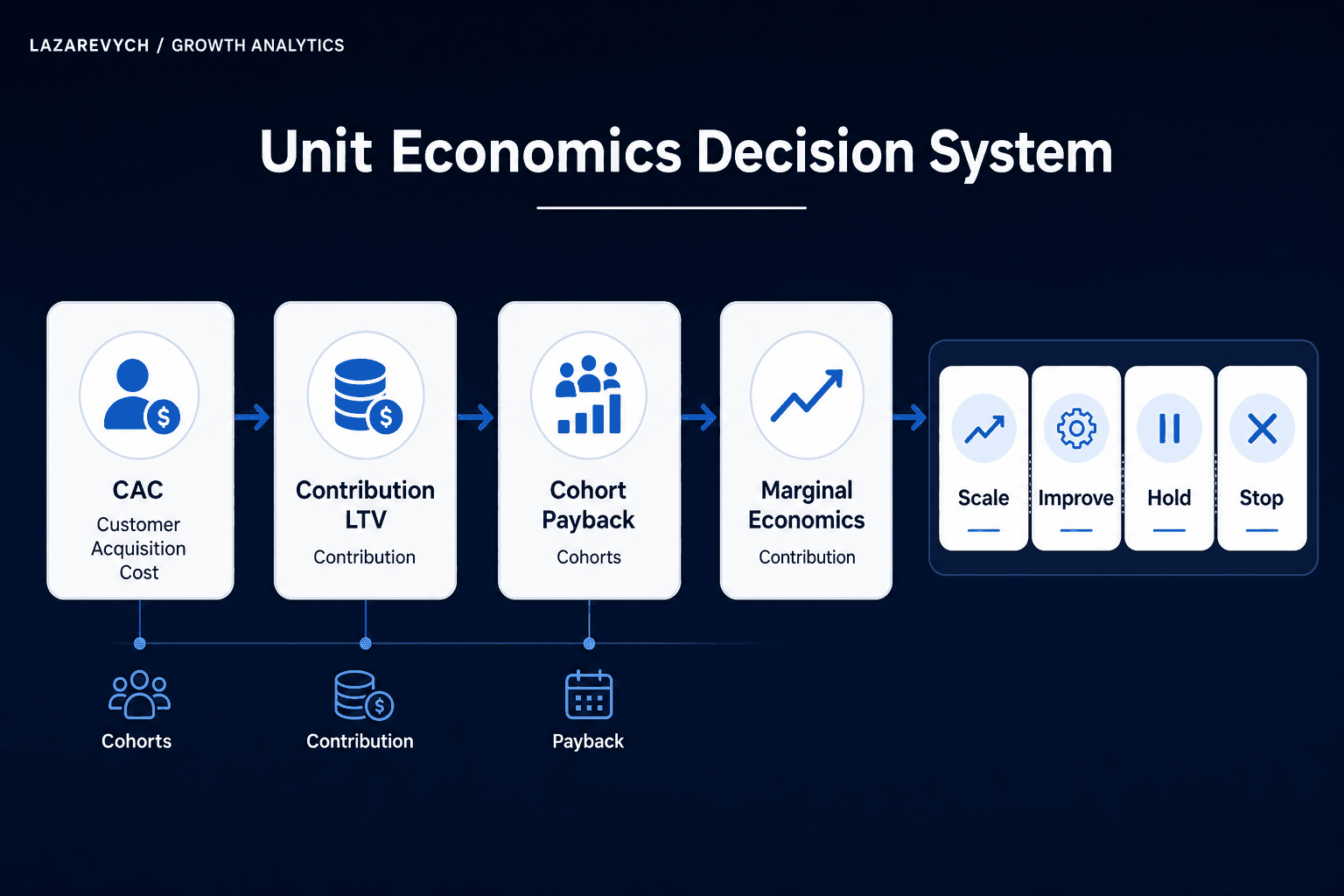
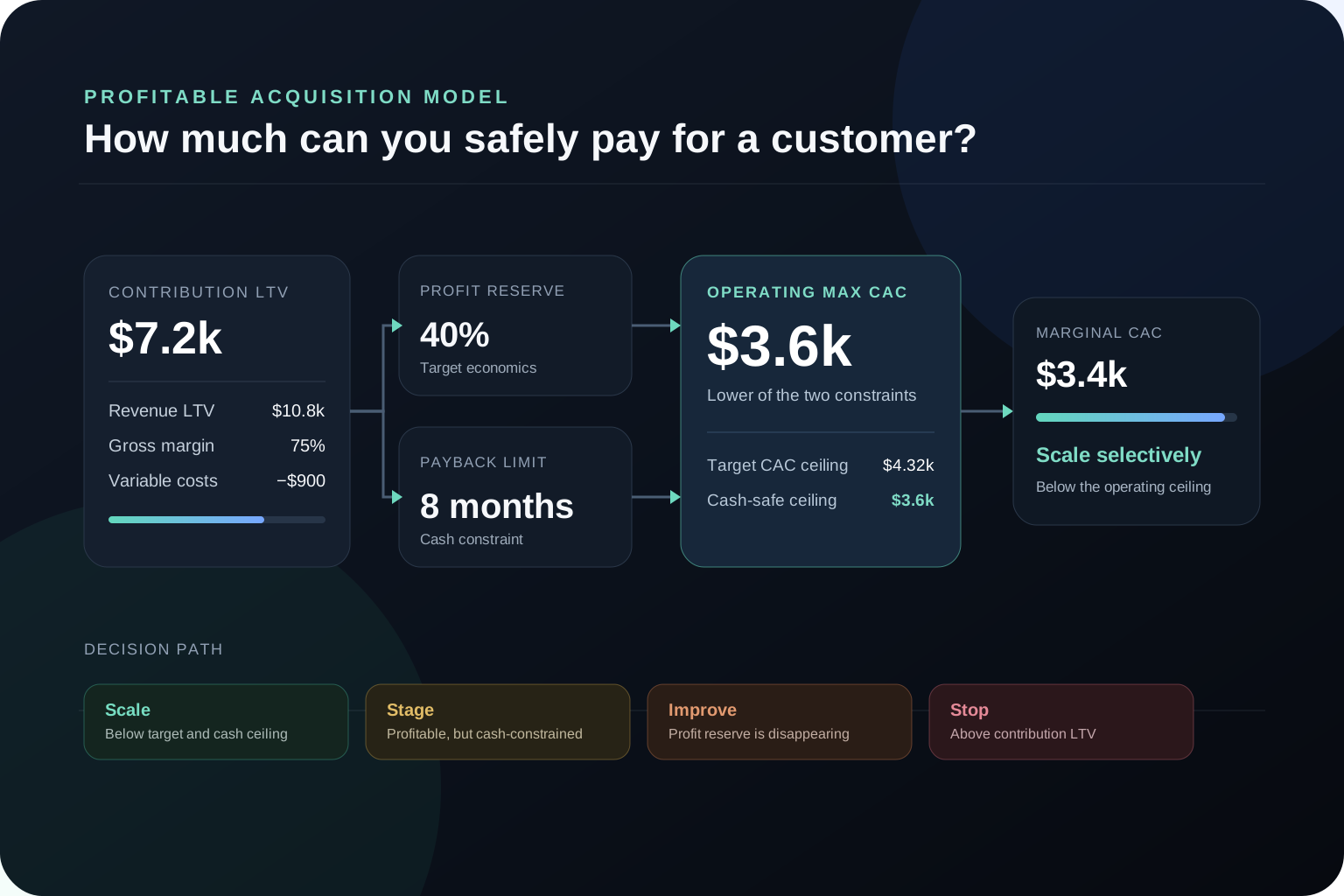
The right engagement usually combines financial logic with growth measurement. It separates advertising CPA from fully loaded CAC, revenue LTV from customer contribution, historical cohorts from forecasts, and blended performance from the marginal economics of the next dollar spent.
The short answer
Hire specialist support when the business decision is expensive and the inputs are disputed, fragmented or immature. A useful project defines the customer and cost scope, reconciles Ads, CRM, billing and finance data, models CAC and contribution LTV by cohort or segment, stress-tests retention and payback, and produces a documented scale, fix, hold or stop rule.
If your source data is already clean and the question is limited, start with the Predictive LTV & Payback Calculator. If the model changes a hiring plan, fundraising narrative or six-figure growth budget, independent review is usually more valuable than another template.
What a SaaS unit economics consultant should deliver
Unit economics consulting for SaaSsits between finance, marketing, sales, product and data. Each team may own a valid number, but those numbers often describe different customers, time windows or costs. The consultant's job is to create one explicit contract for how the business will measure customer value and acquisition efficiency.
Table 1. Minimum scope for a decision-grade SaaS unit economics engagement
Swipe horizontally to view all columns →
Table 1. Minimum scope for a decision-grade SaaS unit economics engagement
Workstream
Question to resolve
Evidence at handover
Metric contract
What counts as CAC, a new customer, contribution and churn?
Definitions, inclusions, exclusions, owners and update cadence
Data reconciliation
Do Ads, CRM, billing and finance describe the same cohorts?
Record-level checks and documented source-of-truth hierarchy
Cohort model
How do retention, expansion and contribution develop over time?
Observed curves separated from modeled future periods
Segmentation
Which channels, plans or markets create different economics?
Comparable CAC, payback and value views at decision level
Decision design
What evidence allows more spend, and what stops it?
Budget guardrails, review cadence and accountable owner
The consultant may also identify tracking or warehouse work required before the model can be trusted. That does not mean every engagement needs a new data stack. It means limitations must be stated honestly rather than hidden behind precision.
When to hire—and when a calculator is enough
A calculator answers a defined mathematical question. A consultant helps when the harder problem is deciding which inputs are true, how uncertainty should be treated and what action the result should trigger.
Table 2. Calculator, consultant or ongoing analytics partner?
Swipe horizontally to view all columns →
Table 2. Calculator, consultant or ongoing analytics partner?
Option
Best fit
Not enough when
Calculator or template
Inputs are agreed and one scenario needs a quick check
Customer, cost, churn or contribution definitions are disputed
Focused consultant project
A specific scaling, pricing, channel or fundraising decision is blocked
The underlying tracking and data pipelines also need implementation
Ongoing analytics partner
Cohorts, forecasts and budget decisions need continuous review
The need is limited to a one-time model with a clear internal owner
Common triggers include rising CAC while ARR still grows, conflicting board and marketing numbers, a new sales-assisted motion, pricing changes, uncertain payback, or a large budget increase. A SaaS growth strategy consultant should connect those questions to operating data rather than recommend growth in the abstract.
The unit economics model that supports scaling
The formulas themselves are straightforward. The model becomes decision-grade only when cost, value and time are measured on compatible bases. The detailed CAC, LTV and payback methodology guide explains the calculations. A consulting engagement should go further in four areas.
Fully loaded CAC: separate media CPA from the agreed sales and marketing costs required to create a new customer.
Contribution LTV: use gross profit or contribution after relevant variable service costs—not top-line subscription revenue alone.
Observed and predictive value: preserve actual cohort evidence and label every forecast assumption about churn, expansion and margin.
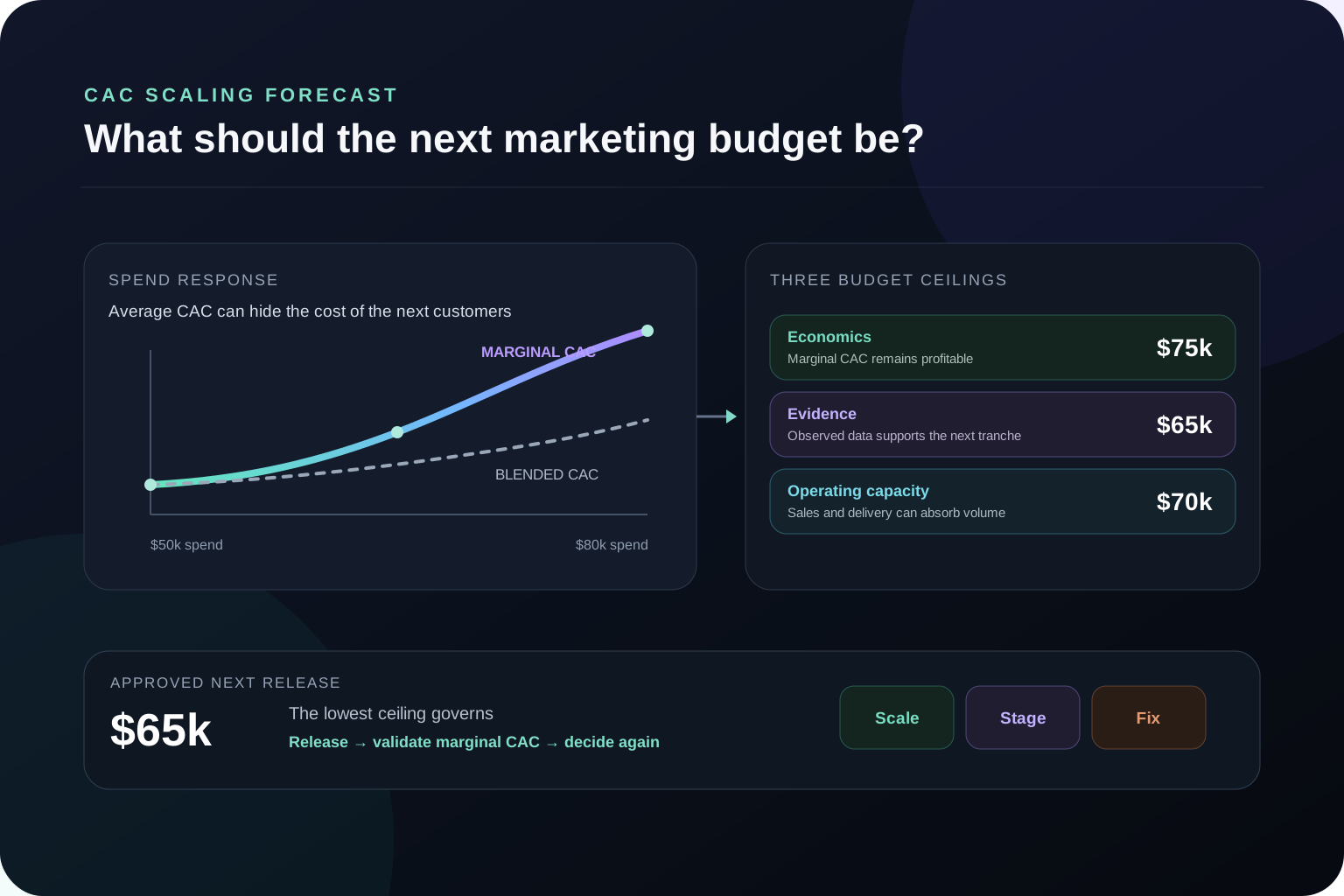
Average and marginal economics: test whether the next budget increment behaves like the historical blended average.
Stripe's official SaaS CAC guidance describes CAC as a cost that may include advertising, sales and marketing team costs, tools and other acquisition expenses. It also presents LTV:CAC and payback as contextual indicators rather than a complete operating model. Review the Stripe CAC in SaaS guide as a useful definition reference, then document the scope your business actually uses.
Evidence-to-allocation framework
Four levels between raw metrics and a scaling decision
01
Observed
Cohort revenue and retention
Start with billing, customer and cost events that actually occurred.
02
Reconciled
One definition across systems
Align Ads, analytics, CRM, billing and finance to the same customer and period.
03
Modeled
Stress-tested future value
Separate observed contribution from assumptions about churn, expansion and margin.
04
Decision
Budget guardrail and owner
Translate economics into a scale, fix, hold or stop rule with a review cadence.
A consultant should make the evidence ladder visible. Leadership must be able to distinguish recorded outcomes from assumptions and from the final capital-allocation rule.
Data and systems required
Good modeling begins with a source map. Acquisition systems explain spend and attributed demand. The CRM explains accounts, opportunities and sales motion. Billing explains invoices, subscriptions, discounts, expansion and cancellation. Finance explains recognized costs and the contribution basis leadership accepts.
Table 3. Inputs and systems for SaaS unit economics consulting
Swipe horizontally to view all columns →
Table 3. Inputs and systems for SaaS unit economics consulting
Input
Likely system
Control to test
Spend and acquisition cost
Ad platforms, payroll, finance and vendor ledger
Consistent inclusion rules and period alignment
Customer identity
CRM, product database and billing
One customer/account key; exclude reactivations and duplicates
Revenue movement
Billing and subscription ledger
New, expansion, contraction, churn, refunds and credits
Contribution costs
Finance, cloud, support and payment systems
Separate fixed overhead from customer-variable cost
Acquisition source
Analytics, CRM and campaign taxonomy
Stable source at customer creation, not last-touch overwrite
Public companies also disclose that metric definitions are company-specific. For example, Nuvini's SEC-filed materials explicitly describe its own LTV and CAC calculation method. The lesson is not to copy that formula; it is to make your own method equally explicit. See the official SEC filing.
Illustrative SaaS example: one average, three payback profiles
Consider a SaaS company with self-serve, sales-assisted and enterprise motions. Leadership sees one blended payback number and assumes every segment can absorb more budget. A segmented view tells a different story.
The 12-month line is an illustrative management guardrail, not a universal benchmark. Assumptions exclude expansion, contraction and churn after payback.
The same company can have materially different cash-recovery profiles by segment. A blended average would hide the enterprise payback exception.
Self-serve has $900 fully loaded CAC and $95 monthly contribution, producing 9.5 months of payback. Sales-assisted has $4,800 CAC and $525 monthly contribution, producing 9.1 months. Enterprise has $18,000 CAC and $1,450 monthly contribution, producing 12.4 months.
These numbers are illustrative, not market benchmarks. They exclude churn, expansion and contraction after payback. Their purpose is to show why a SaaS payback period consultant should segment the recovery profile before recommending more spend. The enterprise motion may still be attractive, but its cash requirement, pipeline latency and retention confidence need a separate decision.
The next step is sensitivity analysis. If enterprise CAC rises 15%, payback moves from 12.4 to about 14.3 months without any change in contribution. If the team has set a 12-month internal cash guardrail, scaling should pause until pricing, conversion, onboarding or cost-to-serve changes justify a new case.
Deliverables and handover
A proposal for CAC LTV consulting services should name the output, not just the meetings. Depending on scope, the client should receive:
a metric dictionary with customer, cost, value and time definitions;
a source map showing ownership and reconciliation rules;
cohort and segment views with observed-versus-modeled periods;
a transparent CAC, contribution LTV and payback model;
sensitivity cases for churn, margin, CAC and expansion;
a decision framework tied to budget, pricing or channel actions;
a limitations register with data gaps and confidence levels;
documentation and an update process an internal owner can run.
A customer lifetime value modeling consultant should never make the forecast impossible to audit. Inputs, transformations and assumptions must be accessible after handover. If a warehouse model or dashboard is included, the definition layer should remain independent of the presentation layer.
Cost depends on the decision and the condition of the data. A focused review of one SaaS motion is different from reconciling several products, regions, CRMs, billing entities and acquisition channels. Forecast depth, dashboard requirements, warehouse work, stakeholder alignment and ongoing review also change the scope.
On this site, a Growth Analytics Audit starts from $1,000. It can diagnose measurement, acquisition, funnel, CRM, data-quality and unit-economics gaps and produce a prioritized roadmap. A Growth Analytics Partner engagement starts from $2,000 per month for ongoing analytics leadership and decision support. These are published starting points, not a generic fixed price for every unit economics project. Review the current engagement pricing before comparing scopes.
Marketing budget and unit economics consulting should be scoped together when the model will set an acquisition ceiling or growth plan. Use the Marketing Budget & Growth Planner to explore a transparent scenario, then validate whether its CAC and revenue assumptions are supported by your cohorts.
If the main problem is unclear data quality rather than the economics formula, begin with the Growth Audit service. If definitions and data are available but the scaling decision remains unclear, the Unit Economics & Growth Strategy service is the closer fit.
How to choose a SaaS unit economics consultant
Ask candidates to explain how they will separate facts from assumptions and how the model will change an operating decision. Useful evaluation questions include:
How will you define the customer and fully loaded CAC for our sales motion?
Which contribution costs will be included, excluded and documented?
How will you reconcile CRM, billing, analytics and finance records?
How will immature cohorts and forecast uncertainty be represented?
Will the model separate channel, plan, market and cohort economics?
How will marginal CAC and the next budget increment be tested?
What files, documentation and ownership will remain after handover?
Which recommendation would make you advise us not to scale?
Red flags include guaranteed growth outcomes, benchmark targets presented as universal truth, revenue LTV compared with narrow media CPA, no record-level reconciliation, hidden model logic, or a proposal that begins with a dashboard before definitions are agreed.
Frequently asked questions
How much does a SaaS unit economics consultant cost?
There is no single fixed fee because the work can range from a focused diagnostic to a multi-system model and ongoing decision support. On this site, a Growth Analytics Audit starts from $1,000 and an ongoing Growth Analytics Partner engagement starts from $2,000 per month. Final scope depends on data quality, systems, segments, forecast depth and implementation needs.
What should SaaS unit economics consulting deliver?
The engagement should deliver agreed metric definitions, reconciled source data, segment and cohort views, a transparent CAC and contribution-LTV model, payback and sensitivity analysis, documented limitations, and decision rules that connect the model to budget allocation.
How much data is needed for a SaaS unit economics analysis?
You need enough acquisition, billing, retention and cost history to observe meaningful customer behavior. An early-stage company can still build a useful model, but immature cohorts and small samples must be shown as uncertainty rather than converted into precise long-term forecasts.
Can a calculator replace a SaaS payback period consultant?
A calculator is useful when definitions and inputs are already trustworthy. A consultant becomes valuable when teams disagree about CAC scope, customer identity, churn, contribution margin, cohorts, attribution or the budget decision that should follow from the output.
Is a SaaS unit economics consultant the same as a fractional CFO?
The roles can overlap but are not identical. A fractional CFO usually owns broader financial planning, reporting and capital strategy. A unit economics consultant may go deeper into acquisition data, attribution, cohort behavior, CRM and billing reconciliation, marginal CAC and growth-budget decisions.
How long does a SaaS unit economics consulting project take?
A focused diagnostic can be shorter than a full implementation. Broader analytics implementations on this site are generally planned over roughly two to six weeks, depending on access, the number of systems, data quality, cohort complexity and whether reporting or integrations must be built.
Make the next growth decision defensible
Review your SaaS unit economics before scaling
Share the acquisition, billing and cohort context behind your current model. We will identify whether the constraint is definition, data, analysis or implementation.
Connect SaaS acquisition cost to contribution, payback and budget
Share the model you use today, the systems behind it and the growth decision it needs to support. The first step is to identify whether the gap is definition, data, analysis or implementation.
A practical guide to CAC, LTV and payback that separates decision-grade unit economics from misleading averages—so growth leaders know when to scale, investigate or stop spend.
Forecast CAC at higher spend, separate average from marginal performance and release the next marketing budget only when economics, evidence and capacity support it.